Build Your First Ecommerce Marketplace With Marketplacer

2
15,168
0
1

Share this post

Post image

As reported by Digital Commerce 360, global consumers have collectively expended more than $3.25 trillion on famous eCommerce marketplaces such as Amazon, Ebay, and Alibaba. This indicates the increasing significance of online marketplaces in customer shopping experiences. 

Therefore, many businesses have promptly devised strategies to enter the race for market share in eCommerce landscape. To achieve this goal, businesses must first develop their own marketplaces. The initial but crucial step in this process is selecting the ideal platform.

The following article focuses on introducing this platform as a recommendation for large businesses among countless optimal choices out there. 

1. What is Marketplacer?

Marketplacer is a Software as a Service (SaaS) platform hosted on AWS, providing businesses with essential tools and features for building professional and highly adaptable eCommerce marketplaces capable of rapid scalability and swift page loading.

Build Your First eCommerce Marketplace with Marketplacer - What is Marketplacer
What is Marketplacer?

This platform streamlines the management and administration of eCommerce marketplaces. It simplifies tasks like order fulfillment, product category adjustments, third-party extension integration, cross-marketplace operational synchronization, and the implementation of strategies for revenue optimization.

To date, this platform has successfully established and expanded over 100 eCommerce marketplaces, forging connections with more than 13,000 sellers spanning the globe.

2. How Marketplacer works?

Build Your First eCommerce Marketplace with Marketplacer - How Marketplacer works
How Marketplacer works?

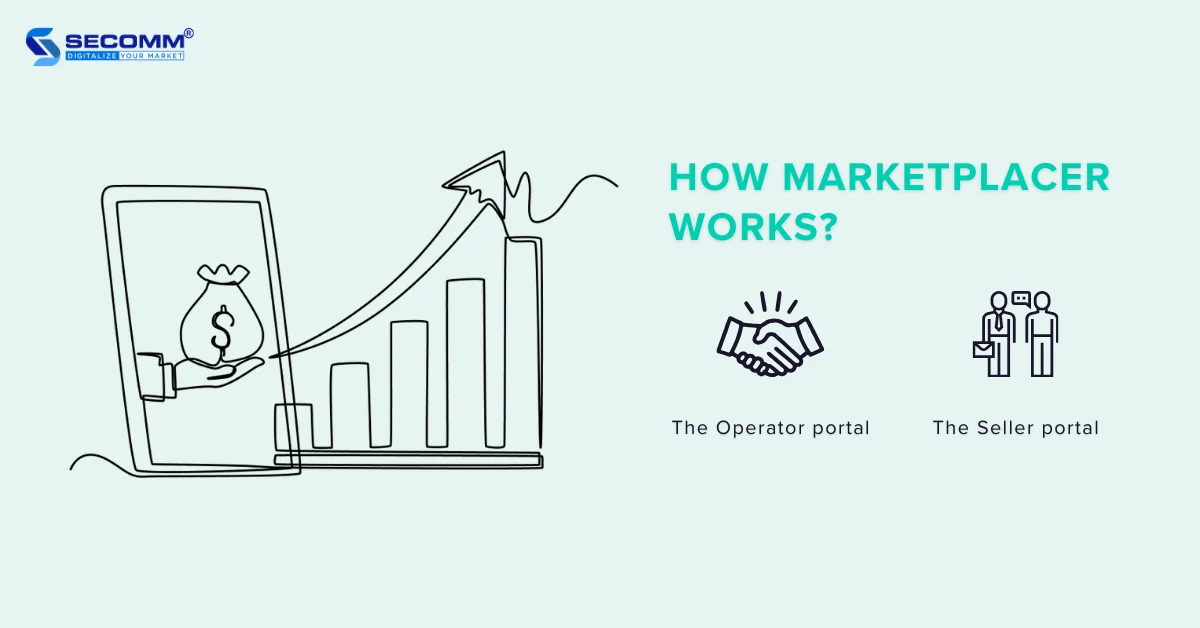
The Operator portal

This platform offers businesses a Marketplace-wide API based on GraphQL API, allowing them to:

  • Build a headless frontend or seamless integration with existing eCommerce systems.
  • Access and manage all data on the online marketplace via the Operator Portal, which includes:
    • Manage Sellers
    • Manage Seller payouts and billings
    • Product category management
    • Order management
    • Delivery management
    • Content management
    • Custom reporting

Furthermore, Marketplacer provides businesses with access to Webhooks, enabling them to receive notifications from the Marketplacer platform for any changes or updates during their operations.

The Seller portal

This platform provides sellers on the marketplace with Seller API based on V2 (REST) API to

  • Automate their sales processes on the marketplace
  • Access and manage various aspects of their seller data through the Seller Portal, including:
    • Product management
    • Sales & Marketing management 
    • Order management
    • Inventory management
    • Analysis & reporting

Similar to how businesses operate their business on the marketplace, sellers also have access to webhooks for receiving notifications regarding changes throughout their selling journey.

3. Marketplacer implementation models

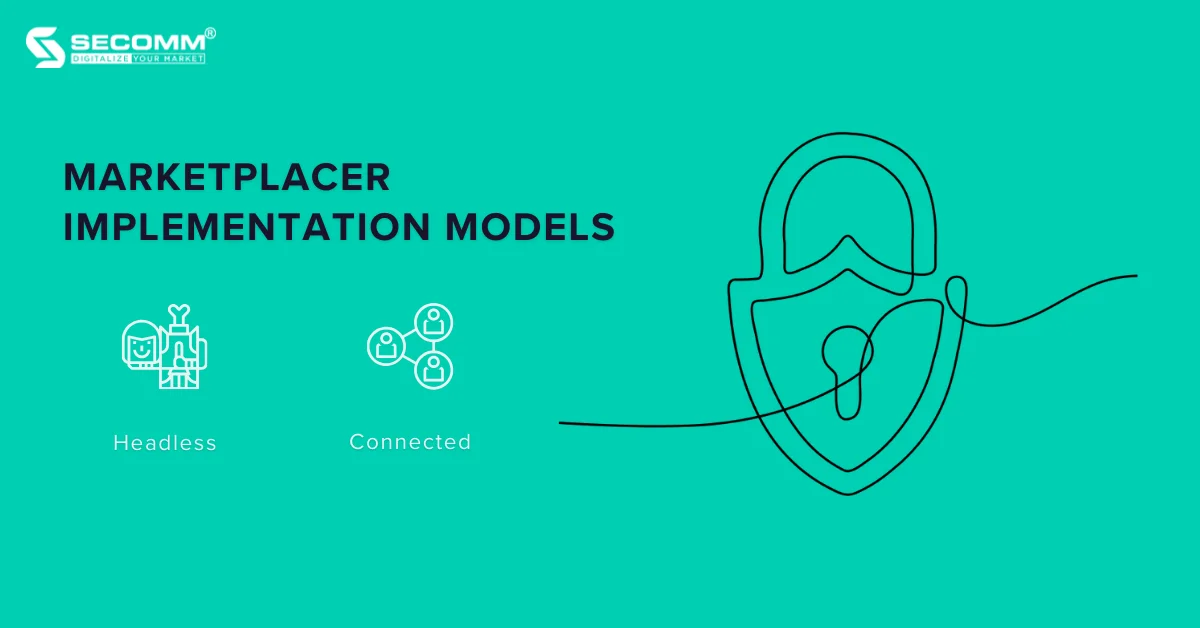
This platform offers two implementation models, allowing businesses to tailor the development of their online marketplace to align with their specific goals.

Build Your First eCommerce Marketplace with Marketplacer - Marketplacer Implementation Models
Marketplacer Implementation Models

Headless

The Headless model empowers businesses to utilize their tailor-made frontend, commonly known as the “head,” which represents the user interface. This frontend is integrated with Marketplacer’s fundamental backend through APIs to execute the marketplace. 

Therefore, opting for the Headless model is ideal for businesses seeking extensive control over the user experience while leveraging Marketplacer’s core technology to foster eCommerce growth.

Connected

In the Connected model, businesses can efficiently integrate a pre-built eCommerce system into Marketplacer’s backend, avoiding the need for an extensive time and financial resources to build from scratch. This integration allows businesses to maintain the full functionality of the pre-existing system while benefiting from this platform’s advanced infrastructure for seamless marketplace deployment.

It’s worth noting that Marketplacer currently offers pre-built connectors exclusively for three prominent platforms: Adobe Commerce, Salesforce Commerce Cloud, and commercetools. As a result, the Connected model is best suited for businesses utilizing one of these three platforms to facilitate their eCommerce.

4. Pros of Marketplacer

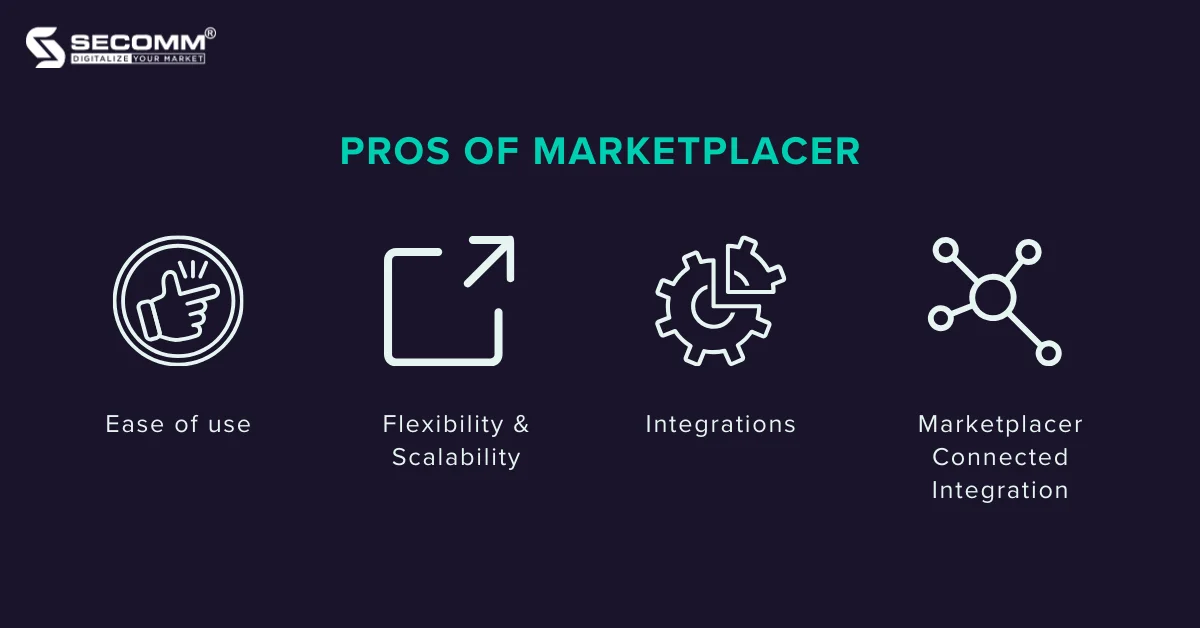
Build Your First eCommerce Marketplace with Marketplacer - Pros of Marketplacer
Pros of Marketplacer

Ease of use

This platform offers a user-friendly interface and intuitive tools, making it simple for businesses to build and manage their online marketplace. 

Flexibility & Scalability

This platform is tailored to suit online marketplaces of diverse sizes. The platform boasts excellent scalability and remarkable flexibility, empowering businesses to manage an ever-increasing volume of sellers, customers, and listing products. This facilitates seamless expansion of operations as needed.

Integrations

Businesses can easily discover well-known applications and extensions within Marketplacer’s growing collection of available integrations. Some noteworthy integrations include popular social media platforms like Facebook, Twitter, and LinkedIn, as well as payment gateways such as PayPal, Zooz, Yotpo, and advertising management tools like Fuze, Firstpage, and Citrus Ad.

Marketplacer Connected Integration

Marketplacer’s success is attributed to its ‘Connected’ technology, enabling businesses to deploy their marketplaces with two versatile options: crafting a tailored frontend or integrating seamlessly with existing systems.

Also, businesses can effortlessly blend third-party products into their current inventory, broadening their product range and portfolio with minimal investment and mitigating product lifecycle management tasks. This model is known as the Hybrid Marketplace and has been successfully adopted by enterprises like Amazon, Walmart, and others.

5. Cons of Marketplacer

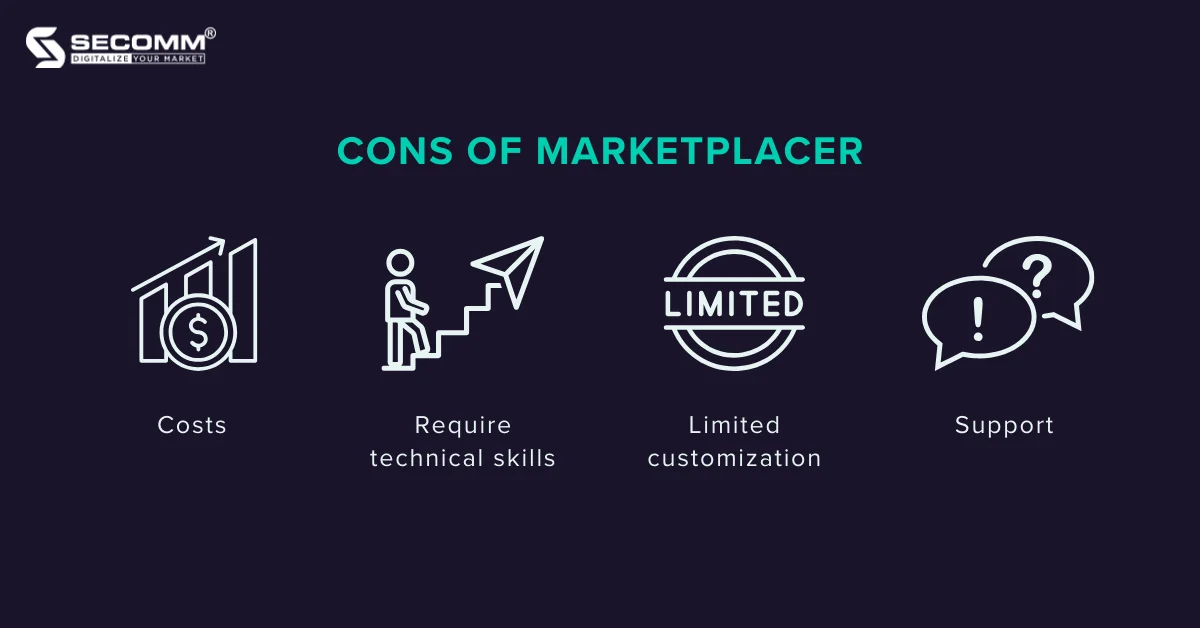
Build Your First eCommerce Marketplace with Marketplacer - Cons of Marketplacer
Cons of Marketplacer

Costs

The license fee isn’t publicly available and businesses are required to reach out to the Marketplacer team for a personalized consultation and cost estimates. Furthermore, the platform doesn’t offer a trial version, which may pose challenges for businesses when planning their implementation budget.

Require technical skills

While this platform offers a user-friendly interface, it may pose challenges for users who are not familiar with building and operating an eCommerce marketplace. Therefore, the implementation process will require businesses to have technical expertise, or they can seek specialized assistance to efficiently build and optimize the platform.

Limited customization

Despite its flexibility and high degree of customization, Marketplacer’s ability to meet the highly complex deployment needs of large-scale eCommerce systems may pose challenges.

Support 

This platform provides 24/7 support services and offers learning resources, but there is room for improvement in the quality and responsiveness of their support. Plus, as an Australian-based company primarily serving the Australian market, some of their terminology might be less clear to international customers.

To successfully build and operate a thriving eCommerce marketplace, the first thing businesses need to do is choose a platform. This platform is one of the standout platforms that businesses should consider.

Feel free to contact or call SECOMM’s hotline at (028) 7108 9908 for free consultations.

Ready to Maximize Your eCommerce Potential? Let’s talk

Leave a comment


Your email address will not be published. Required fields are marked *

Comment (0)

No comments yet. Be the first to comment.
EXPLORE
Related articles
Comparison of AI Automation Capabilities: Magento, Shopify Plus, and Salesforce

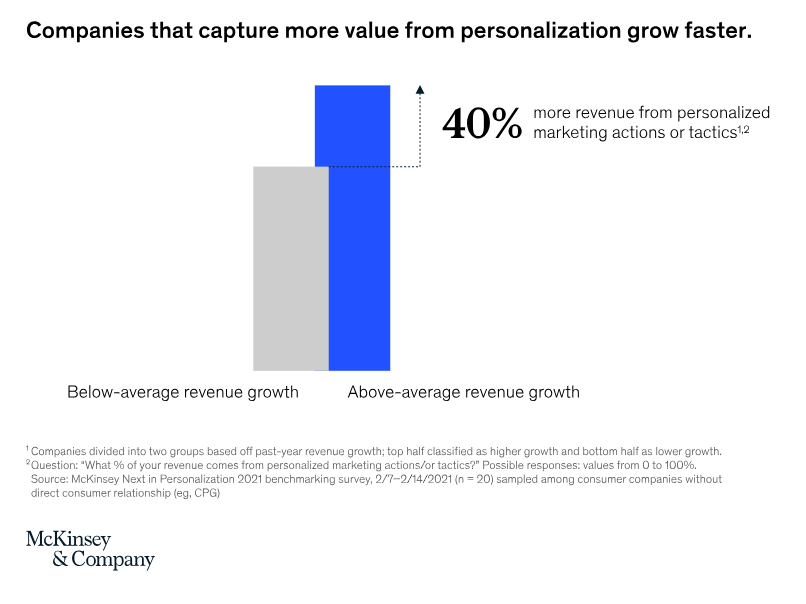
According to a McKinsey AI survey, businesses that effectively implement AI can achieve revenue growth and conversion rates 10% – 30% higher than the average. In the context of rising advertising costs, fragmented customer behavior, and ever-increasing expectations for a “right person – right time – right context” experience, AI automation has become a core competency for every enterprise eCommerce system. This article provides an in-depth comparison of the AI automation capabilities of three leading platforms: Magento (Adobe Commerce), Shopify Plus, and Salesforce Commerce Cloud, helping you determine the optimal choice for your B2B/B2C model and long-term growth strategy.

1. Why is AI Automation a Crucial Factor when Selecting an eCommerce Platform?

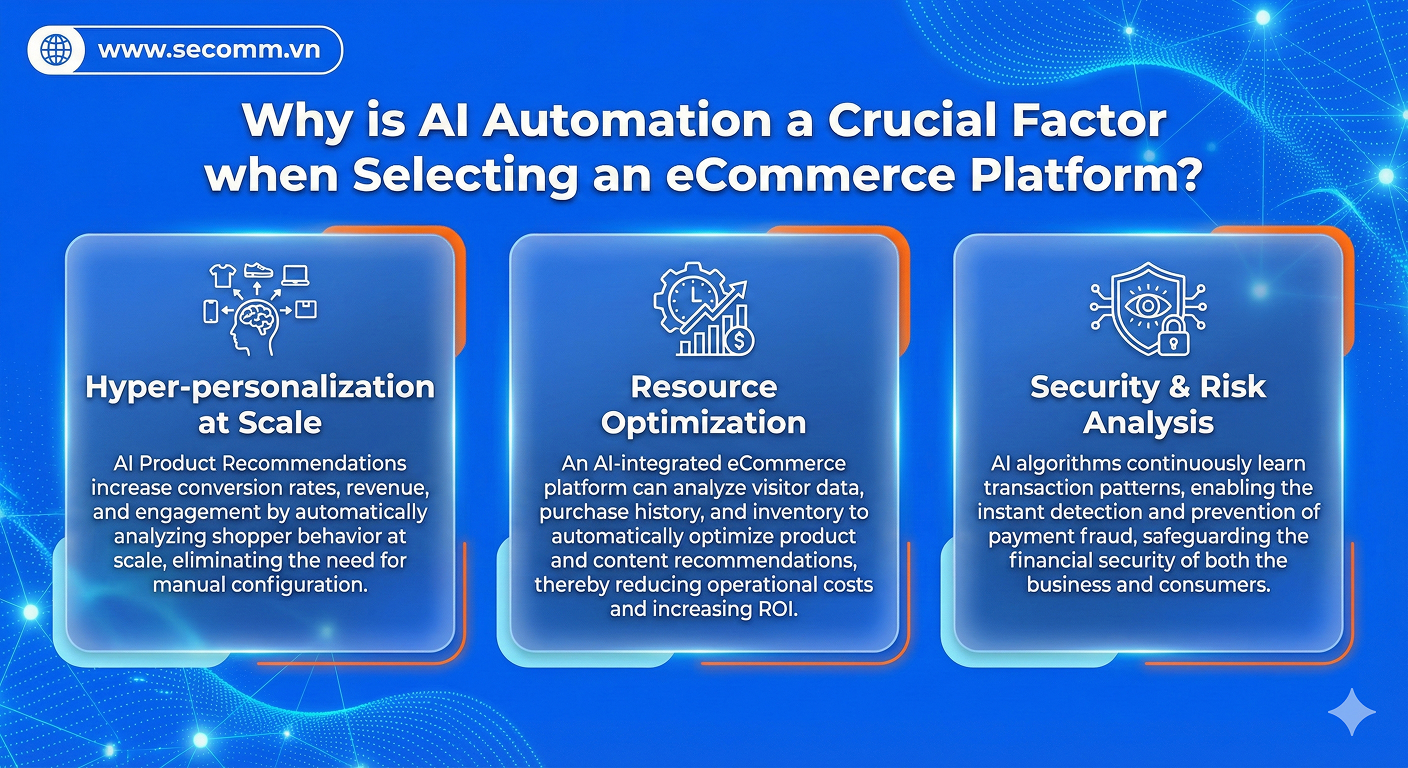
Why is AI Automation a Crucial Factor when Selecting an eCommerce Platform

As e-commerce businesses scale up, manual operations often lead to soaring management costs and fragmented customer experiences. Integrating AI Automation into the core platform is an essential technological solution to address these challenges:

  • Hyper-personalization at Scale: According to Ceymox, AI Product Recommendations increase conversion rates, revenue, and engagement by automatically analyzing shopper behavior at scale, eliminating the need for manual configuration.
  • Resource Optimization: An AI-integrated eCommerce platform can analyze visitor data, purchase history, and inventory to automatically optimize product and content recommendations, thereby reducing operational costs and increasing ROI.
  • Security & Risk Analysis: AI algorithms continuously learn transaction patterns, enabling the instant detection and prevention of payment fraud, safeguarding the financial security of both the business and consumers.

2. Evaluating AI Automation in Magento, Shopify Plus, and Salesforce

Once AI Automation is established as a mandatory factor, the next step for business leaders is to select the core technology that aligns with their scale and specific business model. There is no single “AI formula” that works for every platform. Below is an analysis of the automation capabilities of the three market-leading Enterprise systems.

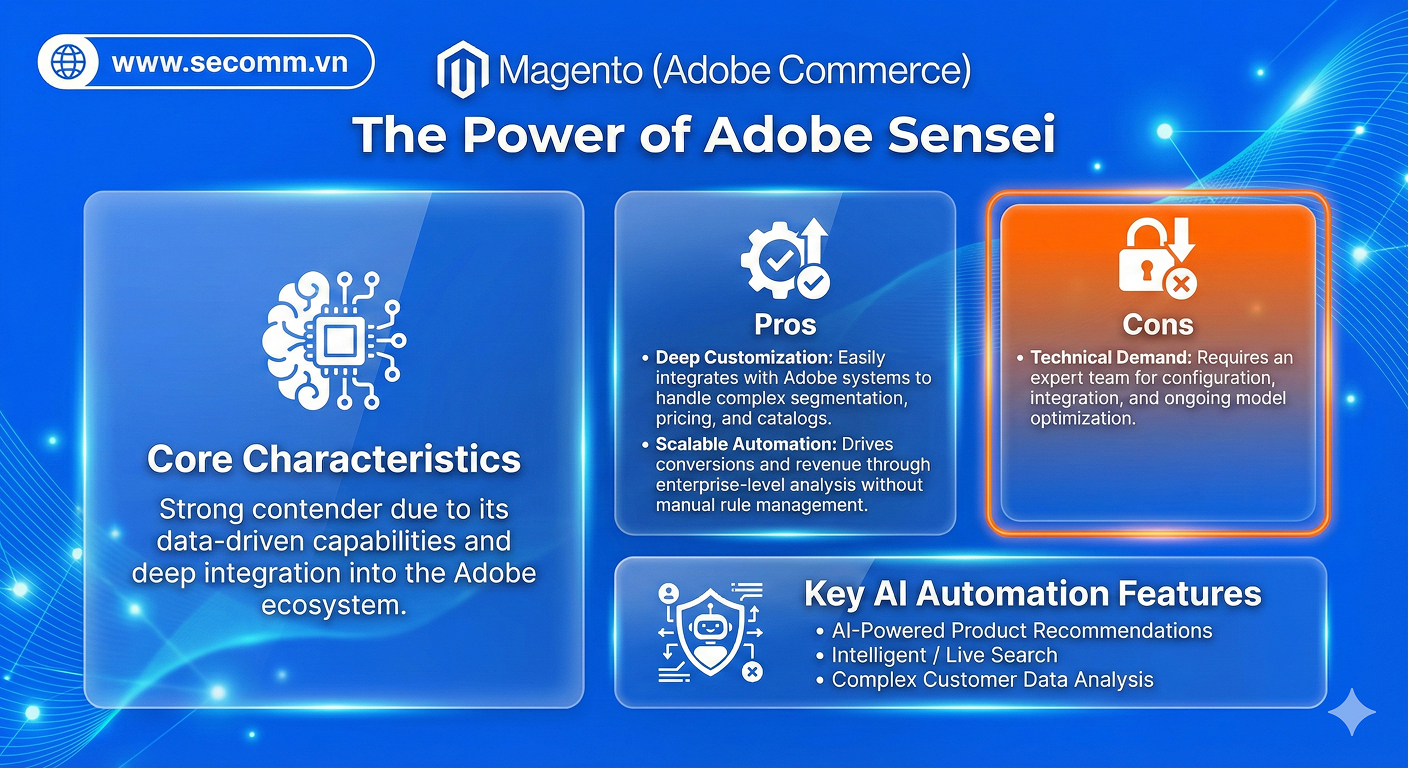
2.1. Magento (Adobe Commerce) & the Power of Adobe Sensei

Magento (Adobe Commerce) & sức mạnh của Adobe Sensei

For businesses with complex and massive data structures, Magento (Adobe Commerce) is always a strong contender due to its data-driven capabilities and deep integration into the Adobe ecosystem.

Core Characteristics:

  • Adobe Commerce integrates Adobe Sensei – the AI/ML platform used to drive intelligent commerce capabilities such as product recommendations, smart merchandising, segmentation, and intelligent search.
  • Sensei analyzes visitor behavior data (browsing history, product data, context) and combines it with the product catalog to create personalized experiences at scale.

Key AI Automation Features:

  • AI-Powered Product Recommendations: Adobe Sensei automatically analyzes shopping behavior using various machine learning algorithms to suggest relevant products (Trending, Viewed-Viewed, Viewed-Bought, More Like This, Most Purchased, Recommended For You, etc.). The system allows merchants to create, manage, and deploy recommendation blocks directly within the Magento Admin, complete with metrics on impressions, views, clicks, and revenue for optimization.
  • Intelligent / Live Search: Sensei upgrades search functionality by understanding intent, handling typos, synonyms, and context to return more accurate results, helping customers find products quickly and correctly.
  • Complex Customer Data Analysis: Sensei can process large volumes of behavioral data and product data in real-time, serving B2B scenarios with large catalogs and diverse pricing structures.

Pros:

  • Deep customization, with the ability to extend AI logic by combining Sensei with other Adobe systems and integrations, suitable for businesses with complex segmentation, pricing, and catalog requirements.
  • Enterprise-scale analysis and automation of product suggestions help increase conversion and revenue without manual rule management.

Cons:

  • Maximizing Adobe Sensei requires an experienced technical team to configure, integrate, and optimize the AI model within the specific context of each business.

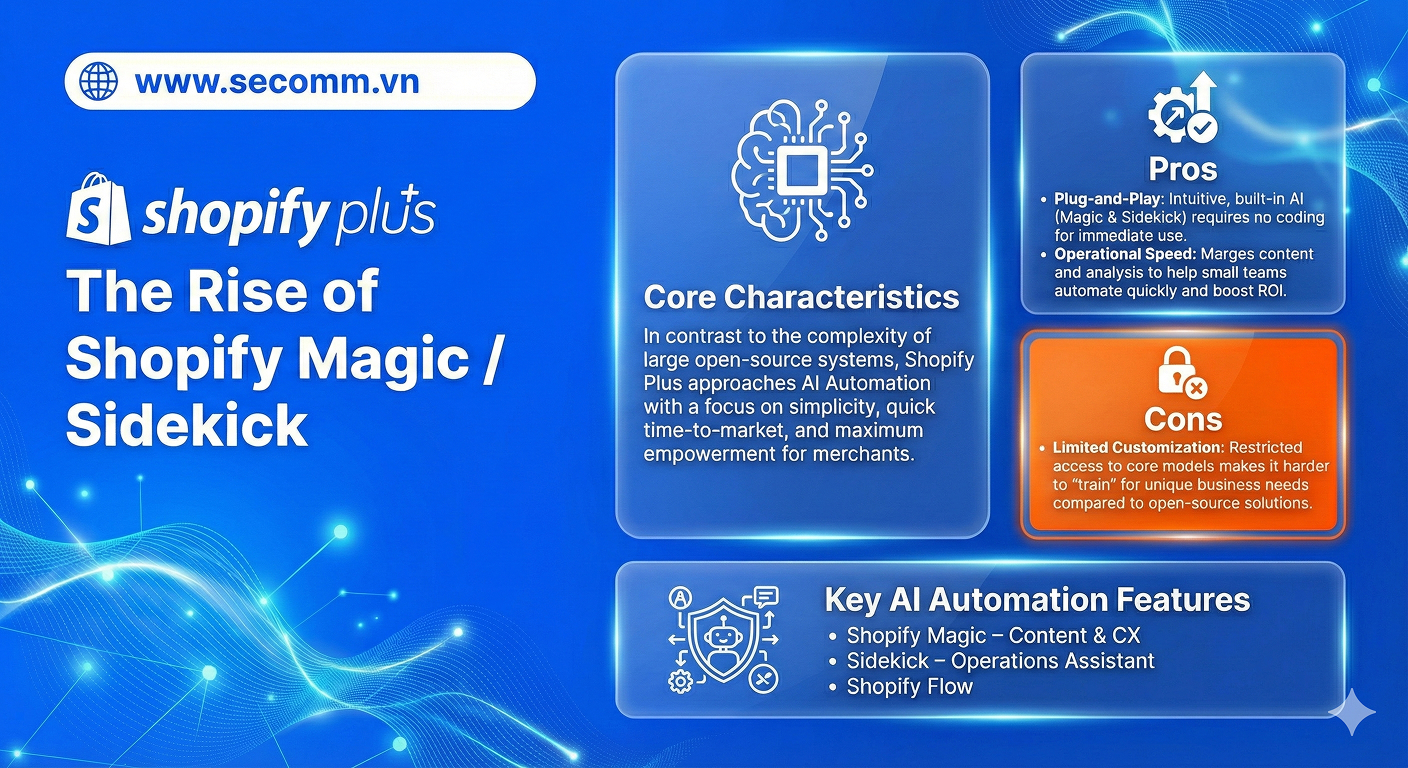
2.2. Shopify Plus & the Rise of Shopify Magic / Sidekick

Shopify Plus the Rise of Shopify Magic Sidekick

In contrast to the complexity of large open-source systems, Shopify Plus approaches AI Automation with a focus on simplicity, quick time-to-market, and maximum empowerment for merchants.

Core Characteristics:

  • Shopify positions its AI suite under the brand Shopify Magic, focusing on helping merchants generate content, optimize operations, and quickly make decisions without extensive technical knowledge.
  • Sidekick is a conversational AI assistant integrated directly into the Shopify Admin, allowing merchants to control their store using natural language.

Key AI Automation Features:

  • Shopify Magic – Content & CX: Shopify Magic assists in writing product descriptions, emails, marketing content, and answering customer questions with a brand-appropriate tone, saving time in content production.
  • Sidekick – Operations Assistant: Sidekick allows merchants to request actions like “create a new product,” “view recent orders,” or “report on best-selling products last month” via text/voice; the system will query data and either execute or provide detailed instructions. Sidekick analyzes sales data, customer behavior, and inventory to generate reports, suggest marketing campaigns, and flag opportunities or risks in near real-time.
  • Shopify Flow: Enables workflow automation (inventory alerts, customer tagging, email triggers, etc.), and AI insights can be used as conditions to trigger flows.

Pros:

  • Intuitive interface; most AI features (Magic, Sidekick) are integrated by default, allowing merchants to use them immediately without deep code intervention.
  • AI combines content generation and operational analysis, helping smaller teams implement AI Automation, improving time-to-market and rapid ROI.

Cons:

  • The depth of intervention into the core AI and model customization is more limited compared to open-source platforms or self-hosted solutions; businesses may find it difficult to “train” the model for unique requirements.

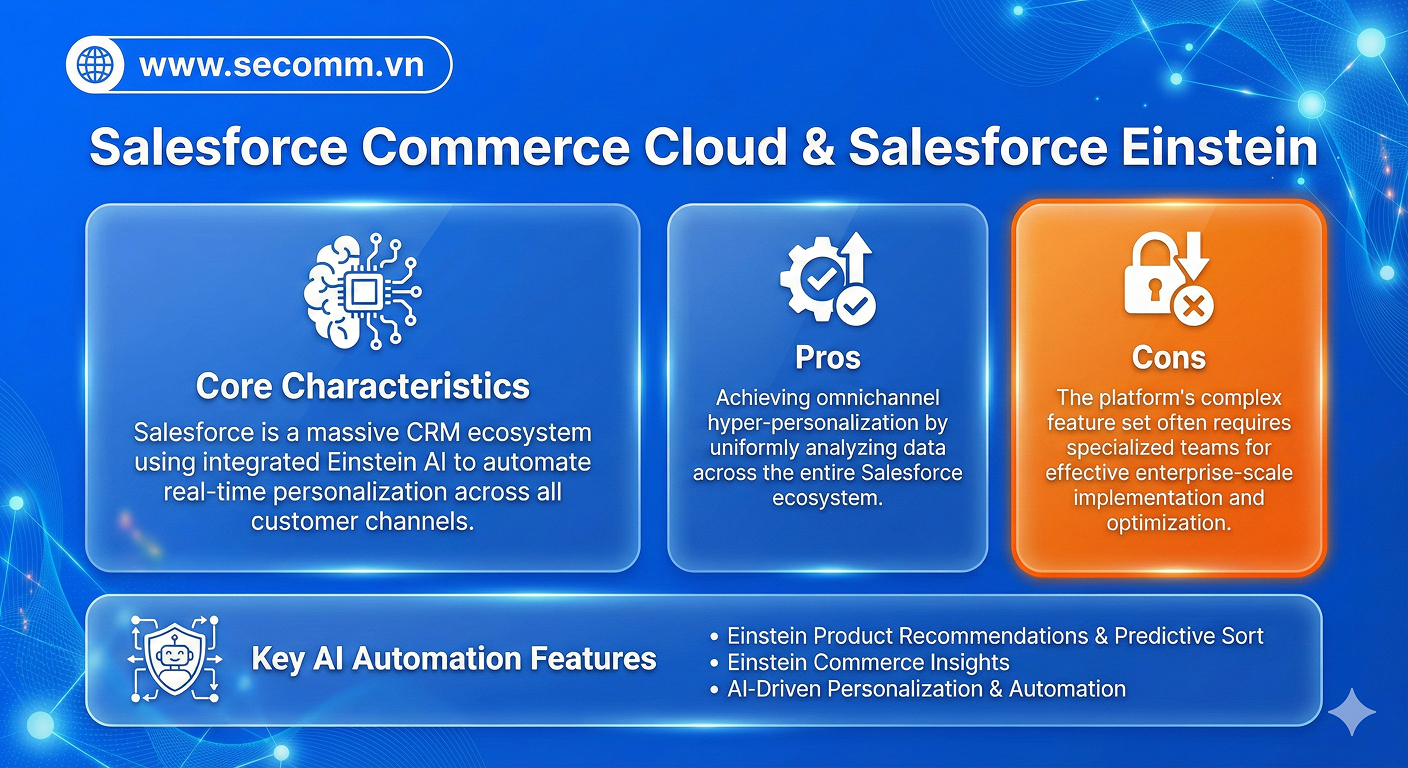
2.3. Salesforce Commerce Cloud & Salesforce Einstein

Salesforce Commerce Cloud Salesforce Einstein

If your Enterprise business is looking for a unified ecosystem across all touchpoints, from marketing and sales to customer service, Salesforce Commerce Cloud offers the most macroscopic level of automation. This platform solves operational challenges with a customer-centric approach.

Core Characteristics:

  • A massive, customer-centric CRM ecosystem.
  • Einstein is Salesforce’s “AI engine,” integrated across all clouds (Sales, Service, Marketing, Commerce) to analyze customer behavior and automate personalization, merchandising, and forecasting.
  • Commerce Cloud leverages Einstein to synchronize multi-channel customer journey data and make merchandising decisions based on real-time data.

Key AI Automation Features:

  • Einstein Product Recommendations & Predictive Sort: Einstein uses behavioral data, preferences, and purchase history to provide personalized product suggestions and automatically sort search results/categories according to relevance for each customer.
  • Einstein Commerce Insights: Analyzes basket data to find “product affinities” (products frequently bought together), supporting cross-sell, upsell, bundling decisions, and category optimization.
  • AI-Driven Personalization & Automation: Einstein automatically generates dynamic content, personalizes the shopping experience, supports merchandising and inventory decisions, and provides real-time insights for marketers and merchandisers.
  • AI Agents: Salesforce is expanding into “AI agents” (Agentforce) capable of automating customer support, merchandising decisions, and sales forecasting at a higher level.

Pros: The greatest strength is realized when a business uses the full Salesforce ecosystem; data from Sales, Service, Marketing, and Commerce is analyzed uniformly by Einstein, supporting omnichannel hyper-personalization.

Cons: Due to the rich feature set, the AI-driven personalization and automation of Commerce Cloud often require specialized teams or partners for enterprise-scale implementation and optimization.

3. Comparative Summary

CriterionMagento (Adobe Sensei)Shopify Plus (Magic/Sidekick)Salesforce Commerce Cloud (Einstein)
Core StrengthAdobe Sensei AI/ML for product recommendations, intelligent search, and automated merchandising.Shopify Magic + Sidekick AI suite for content creation and store operation via natural language, merchant-friendly.Einstein AI deeply integrated with the entire Salesforce ecosystem for omnichannel personalization and merchandising automation.
Content AISensei supports product suggestions, segmentation, and smart merchandising; content copy often uses third-party solutions.Shopify Magic automatically generates product descriptions, emails, and marketing content within the Admin.Einstein can generate personalized product descriptions and dynamic content within Commerce Cloud.
Intelligent SearchLive/Intelligent Search understands intent, typos, and synonyms for accurate results.Advanced search and recommendations are available; capabilities can be enhanced through apps/AI and Sidekick data analysis.Einstein Predictive Sort arranges results based on customer behavior and preferences.
Technical ComplexityHigh, requires developers and technical teams experienced with Sensei/Adobe Commerce.Low, merchant-friendly, many AI features are ready to use immediately.Very High, often requires specialists/partners for enterprise-scale implementation.

4. Which AI Automation Choice is Right for Your Business?

Integrating AI Automation is not merely the purchase of a new tool, but a strategic investment that reshapes the entire operational ecosystem. Magento, Shopify Plus, and Salesforce all possess excellent AI technologies, but there is no single “perfect answer” for every organization.

Businesses do not need to find the world’s strongest platform, but rather the technology “piece” that is perfectly compatible with their business model, current data structure, and system scale-up vision. Here are suggestions for choosing the right platform for your business:

  • Choose Magento if: Your business has a complex business model, especially B2B, large data volume, dynamic pricing, heavy catalog; Sensei handles behavior and automates recommendation/merchandising; and you require 100% control over data and a self-training AI system.
  • Choose Shopify Plus if: Your B2C/D2C business wants to leverage AI Automation immediately to boost sales and optimize operational costs with a lean IT team.
  • Choose Salesforce if: Your business is at a large Enterprise scale, has a generous budget, and wants to synchronize all customer data flows into a single CRM ecosystem. Einstein connects CRM + Commerce data for hyper-personalization across the entire journey (Marketing – Sales – Service – Commerce).

5. Conclusion

With these differences in AI automation among Magento, Shopify Plus, and Salesforce Commerce Cloud, have you selected the platform that aligns with your operational model, technical resources, and ROI goals?

If your business needs an experienced partner to implement enterprise eCommerce across multiple platforms, from system architecture and AI integration to long-term growth optimization, SECOMM can accompany you from the platform selection consulting phase through technical deployment and long-term operational optimization.

6. FAQ

Q1: Which platform offers the best integrated AI Automation for complex B2B businesses?

Magento (Adobe Commerce) is typically the most optimal choice for complex B2B models. Supported by Adobe Sensei, the platform can handle massive data volumes related to dynamic pricing, diverse product catalogs, and personalize the shopping experience based on business accounts. However, setup requires a highly specialized technical team.

Q2: Is implementing AI Automation on Shopify Plus complex and costly?

No. Shopify Plus is designed with a merchant-friendly philosophy for ease of use. AI tools like Shopify Magic (content generation) and Sidekick (admin assistant) are integrated and can be used immediately without complex code intervention. This helps businesses optimize initial deployment costs (TCO) and achieve ROI more quickly.

Q3: I am currently using the Salesforce CRM system. Am I required to use Salesforce Commerce Cloud for the best AI Automation?

It is not mandatory, but highly recommended. If your business has heavily invested in the Salesforce CRM ecosystem, using Commerce Cloud will help maximize the power of Salesforce Einstein. Customer data from Sales, Service, and eCommerce will be synchronized and analyzed by the same “AI brain,” creating the most seamless and deeply personalized Omnichannel experience. However, you can still integrate Salesforce CRM with Magento or Shopify Plus via API, although this process will require a greater technical effort.

Q4: Will AI Automation completely replace the eCommerce operations team?

No. The goal of AI Automation is to Optimize, not completely Replace. AI will handle repetitive tasks (like inventory synchronization, product suggestions, draft content writing, basic behavior analysis), thereby freeing up time for human personnel to focus on strategic, creative work, and handling complex customer service issues.

Q5: How can I evaluate the ROI when investing in AI Automation on these platforms?

The ROI of AI Automation can be measured through two main aspects:

  • Revenue Growth: The increase in Average Order Value (AOV), Conversion Rate from accurate product suggestions, and Customer Retention Rate.
  • Cost Optimization: The reduction in operational costs (manual data handling labor), reduced return rates (due to more accurate product descriptions/suggestions), and shortened Time-to-market for marketing campaigns.
50
5,856
0
20
What is a CDP? Comparing CDP and CRM: Which Platform is Right for Your Business?

According to research by Harvard Business Review, only 15% of professionals feel they have a comprehensive view of their customer data, making it extremely challenging to create effective online experiences. A common problem is data silos existing between Sales, Marketing, Customer Service, and Product teams. Today, this issue can be resolved with a CDP. So, what is a CDP? How does it differ from CRM, and which platform suits your business best? 

1. What is a CDP? 

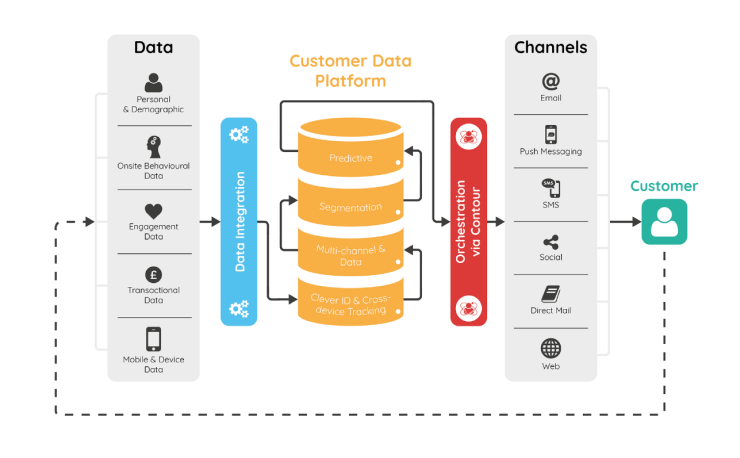
A Customer Data Platform (CDP) is a customer data management system that collects, unifies, and analyzes data from various sources such as websites, mobile apps, social media, CRM systems, and point-of-sale (POS) systems. CDPs enable businesses to create a comprehensive 360-degree customer profile, providing a full view of the customer journey and allowing for personalized experiences at every touchpoint. 

Unlike isolated storage systems, a CDP automatically gathers, cleanses, and synchronizes first-party data (directly owned by the business) in real-time, creating a solid foundation for data analysis and marketing automation. 

SECOMM - What is CDP?

Benefits of Implementing a CDP in Business 

By adopting a CDP, businesses gain numerous advantages: 

  • Consolidation of multi-source data: CDPs gather data from diverse systems, eliminate departmental data silos, and allow comprehensive customer behavior analysis. 
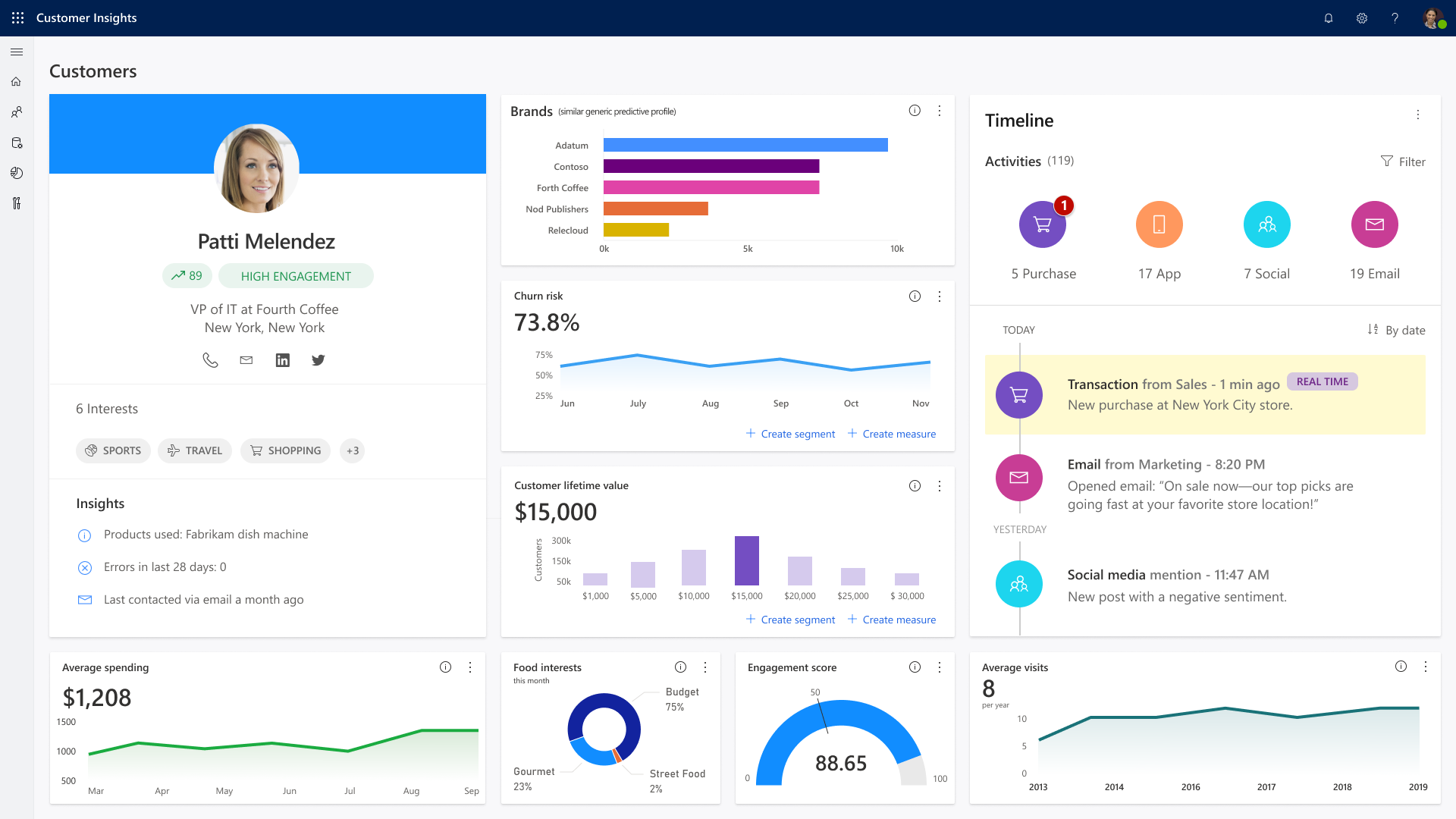
  • Creation of a unified customer profile: By merging all data about each customer into a centralized profile, businesses can easily personalize messages and experiences. 
  • Enhanced personalized marketing: With accurate and complete data, CDPs enable marketing campaigns to target individual customer needs precisely, increasing conversion rates and revenue. 
  • Cost and resource savings: Businesses reduce data duplication, target audiences more effectively, optimize ad spend, and cut down manual tasks. 
  • Improved analytics and forecasting: CDPs provide a centralized analytics platform, helping businesses develop loyalty programs, plan customer care, and expand customer lifetime value (CLV). 

SECOMM - Creation of a unified customer profile

Who Should Use a CDP? 

CDPs are ideal for medium to large businesses that pursue customer-centric strategies or are undergoing digital transformation. 

Specifically: 

  • Omnichannel businesses need unified data from websites, social media, stores, hotlines, etc., for a consistent customer view. 
  • Companies in eCommerce, finance, telecommunications, and retail aim to deploy large-scale personalized marketing. 
  • Marketing and customer service teams want to reduce IT dependency and independently run campaigns based on unified data. 

Application of CDP in eCommerce 

Personalized Multichannel Marketing Campaigns

An eCommerce company uses a CDP to gather customer behavior data from its website, social media, email, and mobile app. When a customer frequently searches for sports products, the CDP automatically segments them and sends personalized email recommendations and timely promotions, delivers relevant content on Facebook, and displays personalized banners during website visits. This leads to significantly higher conversion rates and sales across marketing channels. 

Optimizing Sales Processes and Upselling

Sales teams access consolidated CDP data: purchase history, interaction frequency, product search behavior to identify prospects likely to buy during weekends. The system can send short-term offers or related product promotions, increasing upsell and cross-sell opportunities. 

Customer Journey Coordination and Performance Measurement

CDPs help marketers design seamless customer journeys from discovery to purchase and post-sale care. Businesses can identify and act on customers’ “golden moments” (e.g., purchase decisions triggered by free shipping vouchers). Detailed reports on conversion rates, average order value (AOV), customer acquisition cost (CAC), and effective customer segments optimize marketing strategy and budget. 

CDP vs CRM Comparison

What is CRM? 

Customer Relationship Management (CRM) software or solutions help businesses store, organize, and manage contact information and interaction histories with customers, potential clients, and current clients. CRMs track calls, emails, appointments, transactions, and service feedback and automate many sales and customer service processes. This supports improving customer experience, increasing revenue, and better customer retention. 

Read more: https://secomm.vn/what-is-crm-top-5-benefits-of-using-crm-software/

CDP vs CRM Comparison 

Criteria CDP CRM 
Primary Purpose Unified, analytical, and personalized multi-channel data Manage relationships, communication history, and customer care 
Data Type Multi-source first-party data (behavior, transactions, journey, profiles) Communication, existing transaction data with identified customers 
360° Customer Profile Yes Incomplete 
Data Update Frequency Automatic, real-time Mainly manual or semi-automated 
Main Use Cases Customer insight, experience personalization, marketing optimization Sales management, customer support, pipeline tracking 
Primary Users Marketing, data analysis, customer development strategy Sales, customer service, relationship management 


When to Use CDP or CRM? 

  • CDP: Ideal when businesses seek deep customer behavior insights, marketing automation, and personalized multi-channel marketing with real-time data management. 
  • CRM: Suited for companies focusing on managing existing customer care, sales pipeline or increasing customer satisfaction. 

In Conclusion 

In today’s competitive market, delivering a personalized customer experience is no longer optional; it’s a key driver for optimizing marketing efforts and accelerating business growth. Whether you choose a CDP or a CRM platform, selecting the right solution for your specific business needs is essential to improving operational efficiency and customer engagement. 

If you’re looking for a trusted partner to help you implement, operate, and optimize your eCommerce ecosystem, don’t hesitate to reach out to SECOMM. We’re here to support you with expert guidance and tailored solutions to power your long-term growth. 

FAQ 

What is a CDP and how does it work?
A Customer Data Platform (CDP) is a technology system that connects, collects, cleans, and analyzes customer data from various sources to create a unified customer profile. This supports personalization and optimization of the customer journey.
What’s the main difference between CDP and CRM?
A Customer Data Platform (CDP) is a technology system that connects, collects, cleans, and analyzes customer data from various sources to create a unified customer profile. This supports personalization and optimization of the customer journey.
Which businesses should use a CDP?
CDPs fit omnichannel businesses with multiple customer data sources aiming for personalized marketing or marketing automation. If you need centralized data management and marketing optimization, CDP is the right choice.
Is CDP implementation complex and what is needed?
Implementing a CDP requires quality source data, standardized data input processes, cross-department collaboration, and selecting software that fits your business scale. Having a clear digital transformation plan, objectives, and reliable vendors is essential.
Does CDP guarantee increased leads or revenue?
A CDP optimizes data usage and campaign effectiveness but does not guarantee lead or revenue growth. Business outcomes depend on strategy execution and marketing capability.
Is the data stored on a CDP secure?
Most CDP software complies with high data security standards and regulations like GDPR and CCPA. Businesses should choose providers with proper certifications and implement internal data controls.
57
6,615
1
32
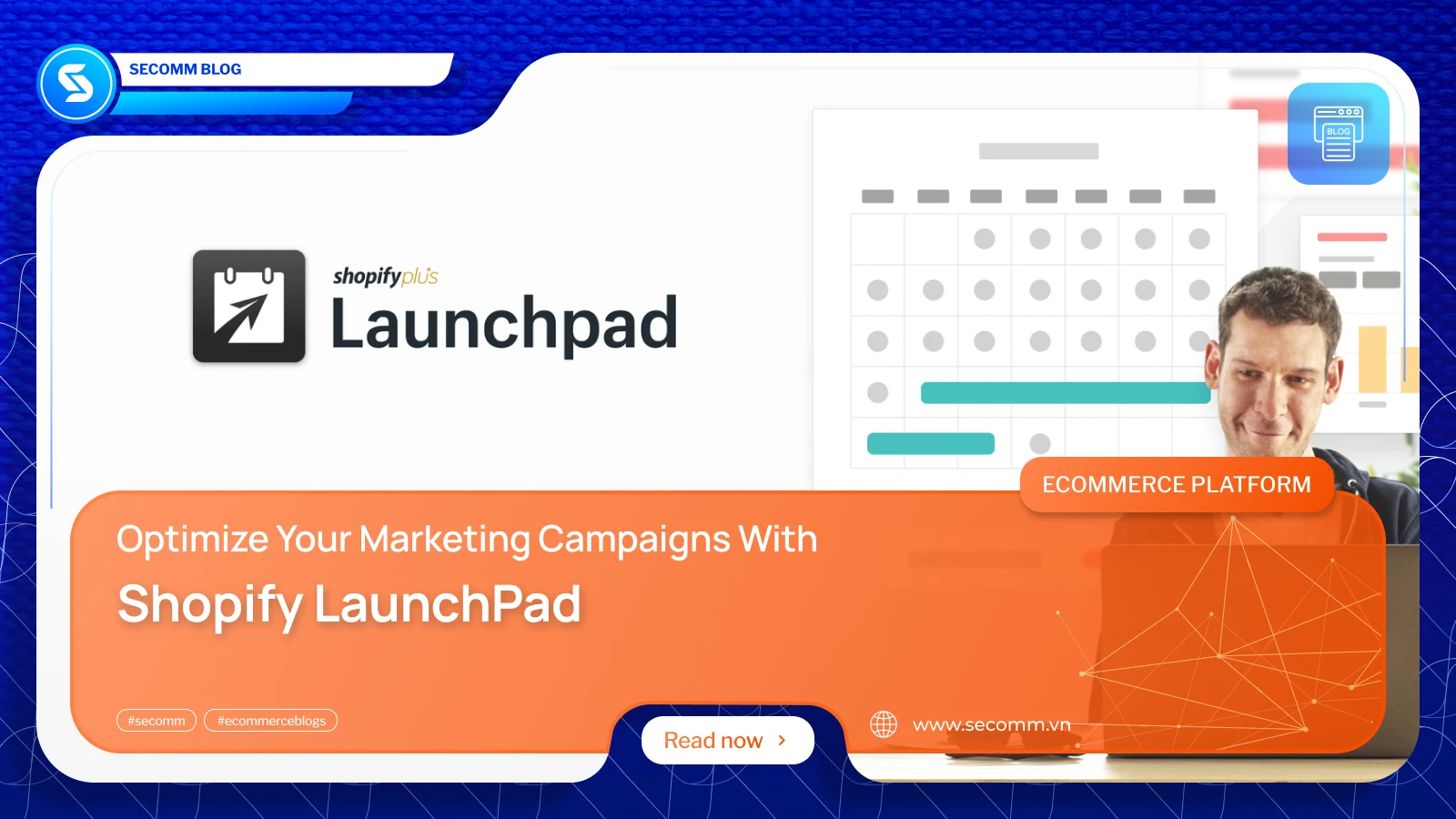
Optimize Your Marketing Campaigns With Shopify LaunchPad

In today’s eCommerce world, staying ahead of the competition requires not only a great product but also effective tools to manage and optimize your store’s operations. Shopify, one of the leading eCommerce platforms, offers a variety of features designed to help businesses thrive. Among these is Shopify LaunchPad, a powerful tool aimed at automating and streamlining promotional events. 

In this blog post, we’ll dive into what Shopify LaunchPad is, how it works, and the key features that make it a valuable asset for online store owners. We’ll also explore the benefits and drawbacks of using this tool, helping you decide if it’s the right fit for your business needs. Whether you’re planning a major sale, a product launch, or a special campaign, understanding the capabilities of Shopify LaunchPad can help you execute your strategies more efficiently and effectively. 

1. What is Shopify LaunchPad? 

Shopify LaunchPad is a specialized feature within the Shopify platform designed to facilitate the management and execution of promotional events for e-commerce businesses. It serves as a comprehensive toolset that allows store owners to automate the setup, scheduling, and execution of events such as product launches, flash sales, and holiday promotions.  

Essentially, Shopify LaunchPad enables businesses to plan and implement their marketing strategies more efficiently by automating repetitive tasks and ensuring timely execution of events, thereby enhancing overall store management and customer engagement.

2. How does it work?

There are two common ways to utilize Shopify LaunchPad. One is creating new events, another is modifying the existing events. Let’s break it down: 

To create a new LaunchPad event, you’ll follow these steps: 

  • Access the dedicated section within your Shopify dashboard for LaunchPad events. 
  • Specify event details such as event type (e.g., sale, product launch), start and end dates, and discount percentages. 
  • Customize other parameters relevant to your promotional strategy. 
  • Confirm the setup to automate the activation and deactivation of events based on scheduled dates. 

To modifying the existing LaunchPad events, you’ll need to: 

Navigate to the LaunchPad events section in your Shopify dashboard. 

  • Locate the event you wish to modify. 
  • Adjust event details such as dates, discounts, and promotional content as needed. 
  • Save the changes to update the event, ensuring your promotions remain relevant and effective throughout the campaign period. 

3. Key features of Shopify LaunchPad 

Shopify LaunchPad offers a comprehensive suite of features designed to enhance the management and execution of promotional events for eCommerce businesses. 

Automated Event Scheduling: LaunchPad automates the activation and deactivation of events based on preset start and end dates, eliminating the need for manual intervention and ensuring timely execution of promotional campaigns. 

Event Customization: Businesses can extensively customize their promotional events within LaunchPad. This includes defining event types such as sales, product launches, or holiday promotions, setting specific start and end dates (including time zones for global campaigns), configuring discounts (whether percentage-based or fixed amounts), excluding certain products or collections, and customizing promotional messaging and banners to align with branding strategies. 

Integration Capabilities: Shopify LaunchPad seamlessly integrates with other Shopify features and third-party apps. It syncs with Shopify’s inventory management to ensure accurate stock availability during promotions, integrates with email marketing tools for targeted promotional campaigns, and connects with analytics platforms to track campaign performance and customer behavior. 

Performance Analytics: The platform provides robust analytics and reporting capabilities, offering insights into event performance metrics such as total revenue generated, units sold, average order value, click-through rates, conversion rates, customer acquisition cost, top-performing products, best-selling categories, and geographic sales distribution. This data empowers businesses to make data-driven decisions to optimize future promotions and marketing strategies. 

4. Benefits of using Shopify LaunchPad 

Using Shopify LaunchPad offers several key benefits for eCommerce businesses: 

Time-saving through automation: Shopify LaunchPad automates the entire process of setting up and managing promotional events. This includes scheduling events to start and end at specific times, activating discounts or special offers automatically, and deactivating them once the event concludes. By automating these tasks, businesses can save significant time that would otherwise be spent manually coordinating promotions. 

Improved sales management: By automating event activation and deactivation, LaunchPad ensures precise control over sales periods, product launches, and promotional campaigns. Businesses can schedule events in advance, allowing for strategic planning and coordination across different channels. This capability not only improves the efficiency of sales management but also enhances the effectiveness of promotional efforts by ensuring timely execution and optimized sales strategies. 

Enhanced customer experience: Streamlined and well-managed promotional events contribute directly to a better shopping experience for customers. With LaunchPad, businesses can communicate promotions clearly and effectively to their audience, reducing confusion and improving transparency. Timely execution of promotions also enhances customer satisfaction by delivering on expectations and providing a seamless shopping experience. 

Reach new potential customers: Shopify LaunchPad is instrumental in helping businesses reach new audiences and expand their customer base. Whether through targeted promotions, cross-channel campaigns, or innovative marketing strategies, LaunchPad enables businesses to attract and engage with new potential customers effectively. 

5. Limits of Shopify LaunchPad 

While Shopify LaunchPad offers significant benefits, it also has certain limitations that businesses should consider: 

Dependence on Proper Setup: The effectiveness of LaunchPad heavily relies on the accurate setup of events, including dates, discounts, and promotional content. Improper configuration or oversight in setup can lead to inconsistencies in promotions or missed opportunities to maximize sales. 

Analytics and Reporting Depth: While LaunchPad provides basic analytics and reporting on event performance, businesses looking for advanced analytics capabilities or deeper insights may find the built-in features somewhat limited. Integrating with external analytics tools may be necessary for more comprehensive data analysis. 

6. Real-world examples 

  • Cheak 

Cheak

Cheak, an innovative sportswear brand, leveraged Shopify LaunchPad to streamline its product launches and manage seasonal sales effectively. By scheduling product releases and flash sales in advance, Cheak was able to create buzz and anticipation among its customer base. The automation provided by LaunchPad ensured that promotions started and ended precisely as planned, enhancing the overall shopping experience and boosting sales during peak periods. By using Shopify LaunchPad, Cheak increased 20% month-on-month growth in online store traffic, 100% month-on-month rise in Malaysian expansion store visits, and reduced product launch time, from 1 week to 2 days. 

  • Bauer 

Bauer

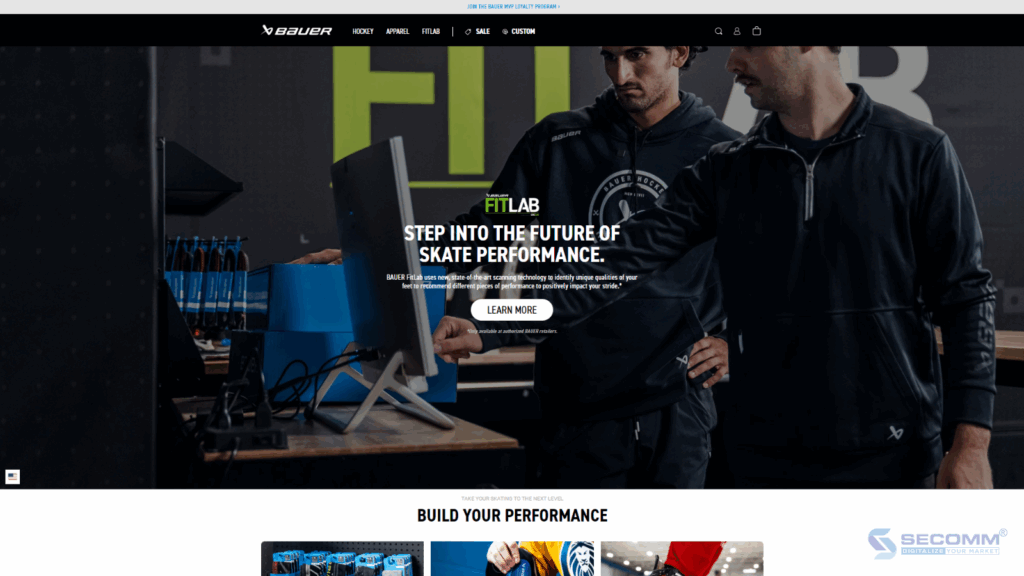
Bauer, a renowned hockey equipment manufacturer, used Shopify LaunchPad after re-platform from Salesforce Commerce Cloud to coordinate large-scale promotional events across multiple regions. By utilizing LaunchPad’s scheduling and automation features, Bauer was able to synchronize discounts and special offers for major events like Black Friday and Cyber Monday. This approach not only simplified the management of these complex campaigns but also maximized their impact, resulting in significant increases in both online traffic and sales. 

Shopify Plus and the LaunchPad feature has helped Bauer with 60% revenue increase, 30% order increase, 20% cost savings, 18% conversion rate increase since moving to Shopify, within 6 months year-over-year. 

  • Cozykids 

Cozykids

Cozykids, a popular children’s clothing retailer, implemented Shopify LaunchPad to manage its frequent sales and special promotions. The brand utilized LaunchPad to automate discount application and promotional messaging, ensuring a seamless and consistent customer experience. With LaunchPad, Cozykids could easily modify ongoing events and respond quickly to market trends, leading to improved customer engagement and satisfaction. By using LaunchPad, Cozykids has seen: 40% site traffic increased, 82% revenue increased, human error reduced and stock management efficiency increased.

7. Final Words 

Shopify LaunchPad is a powerful tool that can transform the way eCommerce businesses manage and execute promotional events. By automating event scheduling, enhancing sales management, and improving customer experiences, LaunchPad offers significant benefits. However, it also has limitations that businesses need to consider. Real-world examples like Cheak, Bauer, and Cozykids showcase its potential to drive sales and engagement effectively. Overall, Shopify LaunchPad is a valuable asset for any eCommerce store looking to streamline its promotional strategies and achieve better results. 

Want to implement Shopify LaunchPad right now? Contact SECOMM for free consultation! 

113
6,498
1
40
Explore articles by category
DIGITAL TRANSFORMATION
ECOMMERCE ECOSYSTEM
ECOMMERCE KNOW-HOW
ECOMMERCE MARKET
SECOMM NEWS
AI-Driven Omnichannel: The Strategy Shaping the Future of Retail in 2026

According to research from Omnisend, campaigns that use three or more channels achieve a purchase rate approximately 287% higher than single-channel campaigns. Omnichannel customers also have an average lifetime value around 30% greater than customers who shop through only one channel. In today’s highly competitive landscape, adopting AI in omnichannel retail is no longer a “nice-to-have” but a “must-have”.

This article explores how AI-driven omnichannel strategies are revolutionizing the retail landscape, offering businesses new ways to leverage technology for long-term, sustainable growth

Personalization and Customer Insights 

Personalization and Customer Insights

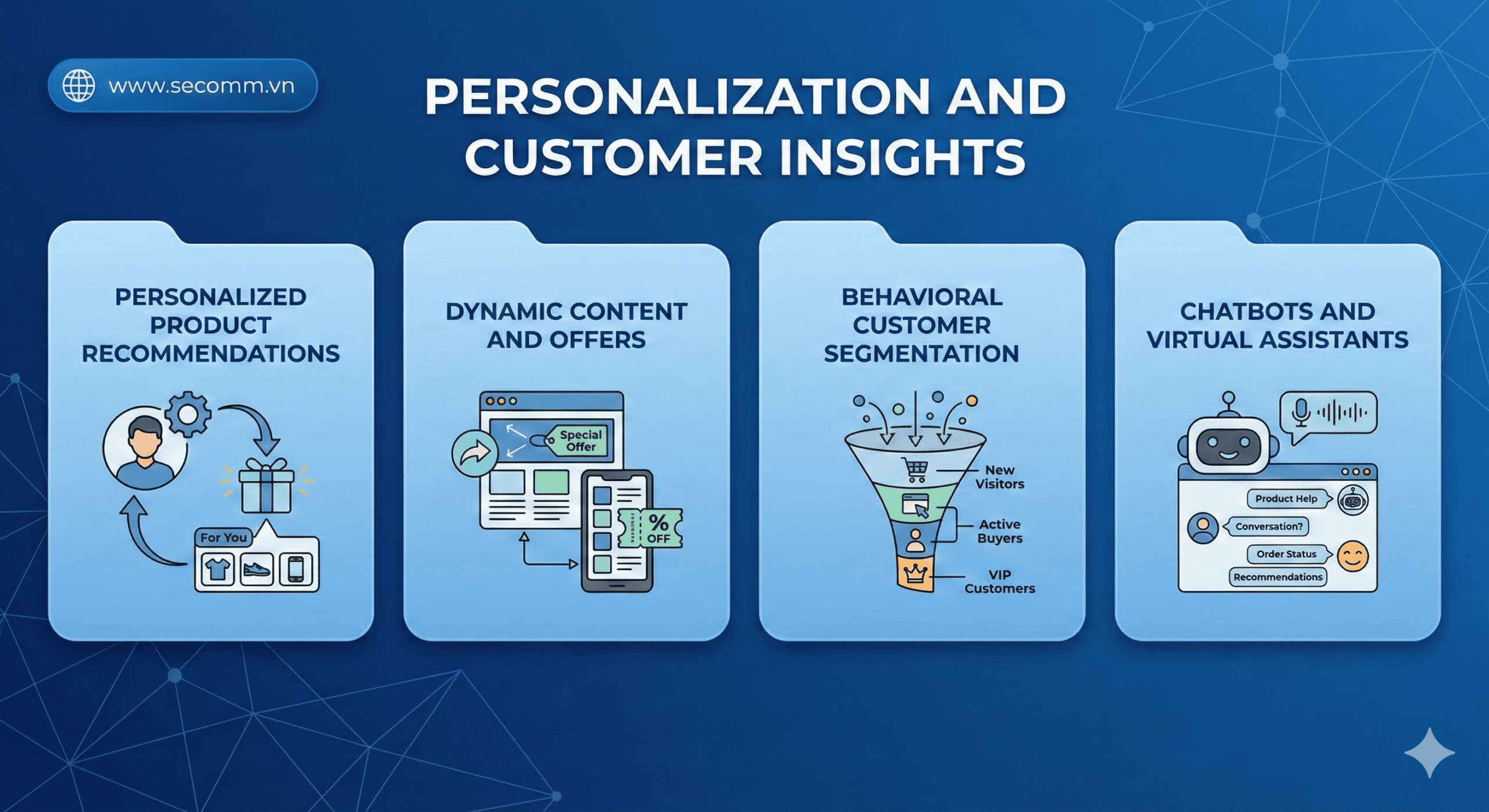
AI enables retailers to deliver personalized experiences by leveraging customer data from multiple sources. With machine learning (ML) algorithms, businesses can analyze browsing behavior, purchase history, and even social media interactions to build a comprehensive customer profile. This profile is then used to power product recommendations, services, and content tailored to each individual. Key AI applications in personalization and customer intelligence include: 

Personalized Product Recommendations 

AI-driven recommendation engines analyze data across all channels to suggest the most relevant products to each customer, thereby increasing conversion rates. For instance, when a shopper searches for a product on a mobile app, AI algorithms can recommend related items based on their purchase history and browsing behavior across platforms. Around 80% of consumers are willing to buy more from brands that offer a personalized experience. 

Dynamic Content and Offers 

With AI, retailers can trigger timely promotions for the right customer segments. If a shopper views a product on the website but leaves without purchasing, AI can automatically send a personalized discount code via email or mobile push notification to encourage them to return and complete the order. This approach boosts engagement and significantly reduces cart abandonment. 

Behavioral Customer Segmentation 

AI supports behavioral segmentation, allowing retailers to cluster customers based on how they shop and interact with the brand. Frequent shoppers can be rewarded with VIP privileges, while low-frequency customers can be targeted with limited-time offers designed to re-engage them and increase purchase frequency. 

Chatbots and Virtual Assistants 

AI-powered chatbots deliver personalized support by accessing customer profiles, order history, and browsing activity. Operating 24/7, chatbots can handle FAQs, assist with product discovery, and even cross-sell or upsell complementary items to increase average order value. A survey from PwC indicates that roughly 87% of consumers believe AI has improved their shopping experience, and 73% are willing to use AI chatbots for customer service during their purchase journey. 

Inventory Optimization with AI in Omnichannel Commerce 

Inventory Optimization with AI in Omnichannel Commerce

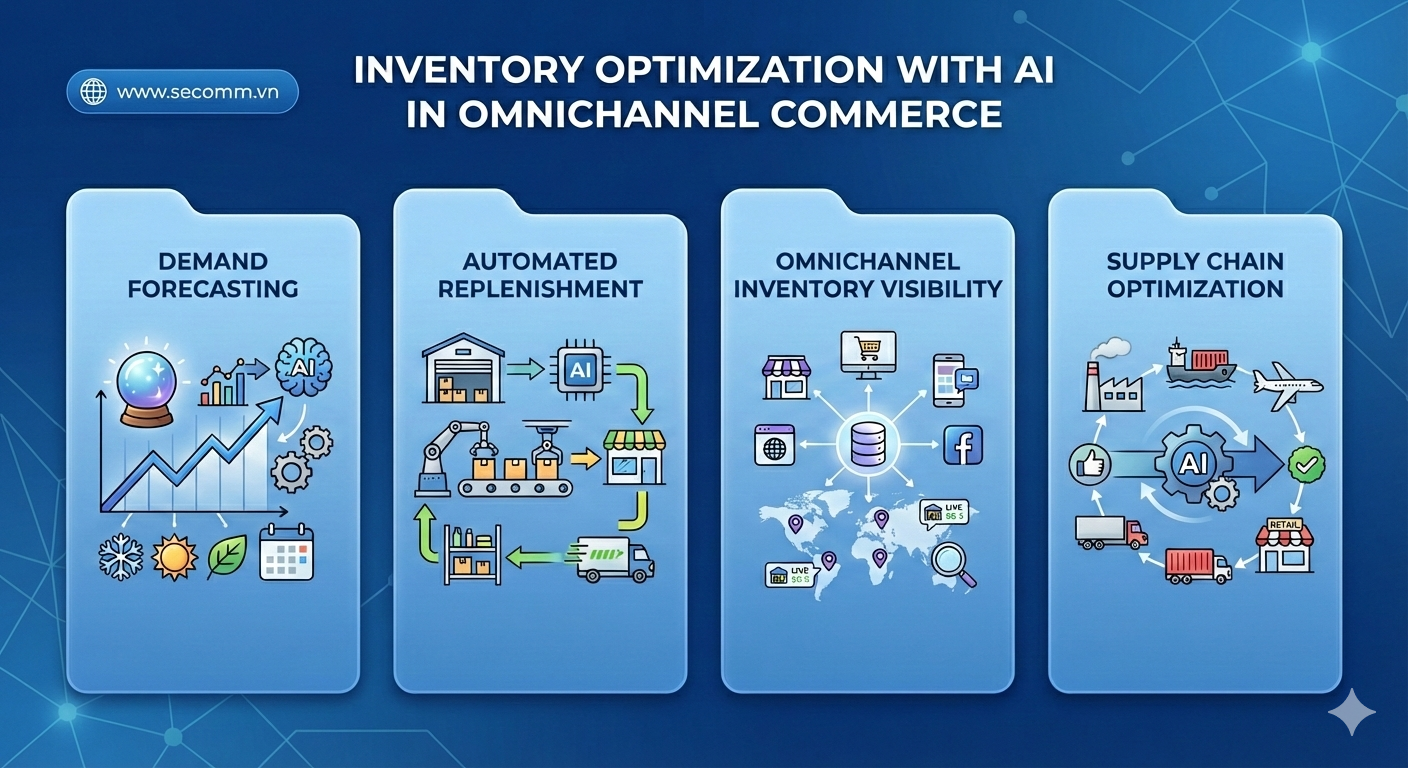
Inventory management in a traditional omnichannel environment is complex and often leads to stockouts or overstock. AI-powered inventory management systems streamline this process, enabling retailers to maintain optimal stock levels across all channels. 

Demand Forecasting 

AI can forecast future demand by analyzing historical sales data, current trends, and external factors such as seasonality. With more accurate demand forecasting, retailers can avoid both out-of-stock situations and excess inventory, reducing markdowns and storage costs. Studies show that AI-driven demand forecasting can reduce forecast error by up to 30%. 

Automated Replenishment 

Leveraging predictive analytics, AI can automate replenishment orders so that best-selling products are always available while minimizing the risk of dead stock. AI can also detect regional demand differences, allowing businesses to fine-tune inventory levels at each store. This creates a more responsive supply chain and can reduce stockout events by up to 40%. 

Omnichannel Inventory Visibility 

AI provides real-time inventory visibility across all channels: online, in-store, and warehouse. Customers benefit from accurate stock information, while retailers can confidently implement services such as “Buy Online, Pick Up In-Store” (BOPIS) without operational friction. This level of visibility also supports more efficient inventory allocation, especially during peak demand periods. 

Supply Chain Optimization 

AI-driven supply chain analytics help retailers optimize logistics and distribution. Algorithms can determine the most efficient delivery routes, streamline warehouse operations, and predict potential disruptions. This is particularly critical for retailers offering same-day or next-day delivery, where AI can identify the fastest and most cost-effective path from fulfillment centers to customers. 

Read more: What is eCommerce Integration? Foundation of eCommerce Automation

Elevating Customer Service in Omnichannel Retail 

Elevating Customer Service in Omnichannel Retail

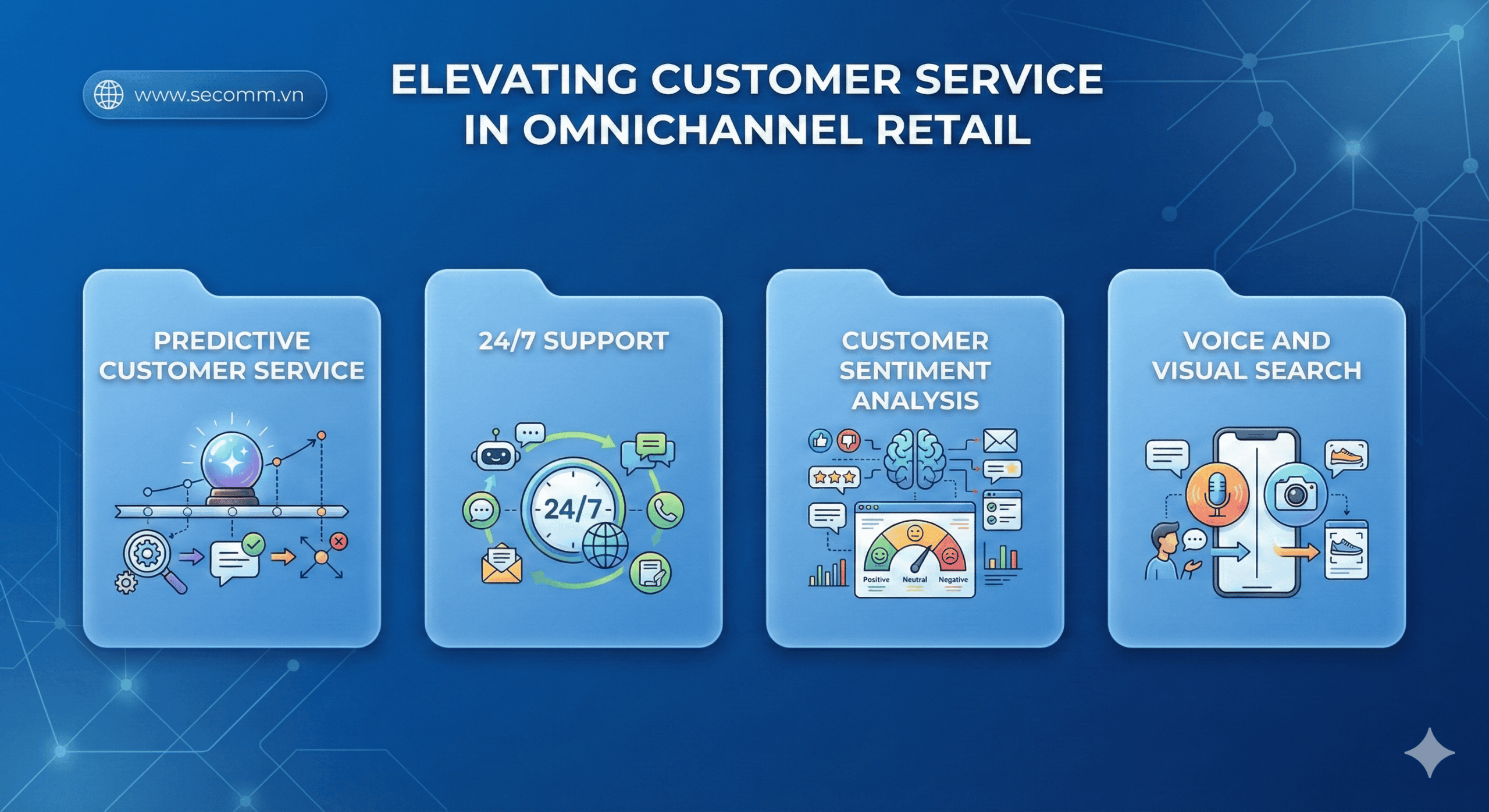
Customer service is a core component of the omnichannel experience, and AI is redefining how retailers engage with shoppers across touchpoints. From virtual assistants to AI-powered analytics, these tools ensure every interaction is more efficient and more relevant. 

Predictive Customer Service 

AI can anticipate support needs before customers submit a ticket. For example, if a customer repeatedly returns a specific product, AI can flag this pattern and alert the customer service team to proactively reach out. This level of predictive service helps reduce churn and strengthens brand loyalty. 

24/7 Support 

AI-powered chatbots and virtual assistants provide round-the-clock support across all channels, reducing waiting times and enhancing customer satisfaction. These virtual agents can handle routine inquiries, track orders, and assist with returns, freeing human agents to focus on complex, high-value interactions. 

Customer Sentiment Analysis 

AI-based sentiment analysis tools allow retailers to monitor customer satisfaction by analyzing feedback across social media, email, and support tickets. The technology can detect negative sentiment in real time, enabling teams to take immediate corrective action to protect the customer experience. 

Voice and Visual Search 

With AI, retailers can offer voice search, allowing customers to find products without typing, which is especially impactful on mobile. Visual search lets shoppers upload images to discover similar items, delivering a more intuitive and convenient product discovery experience aligned with modern consumer behavior. 

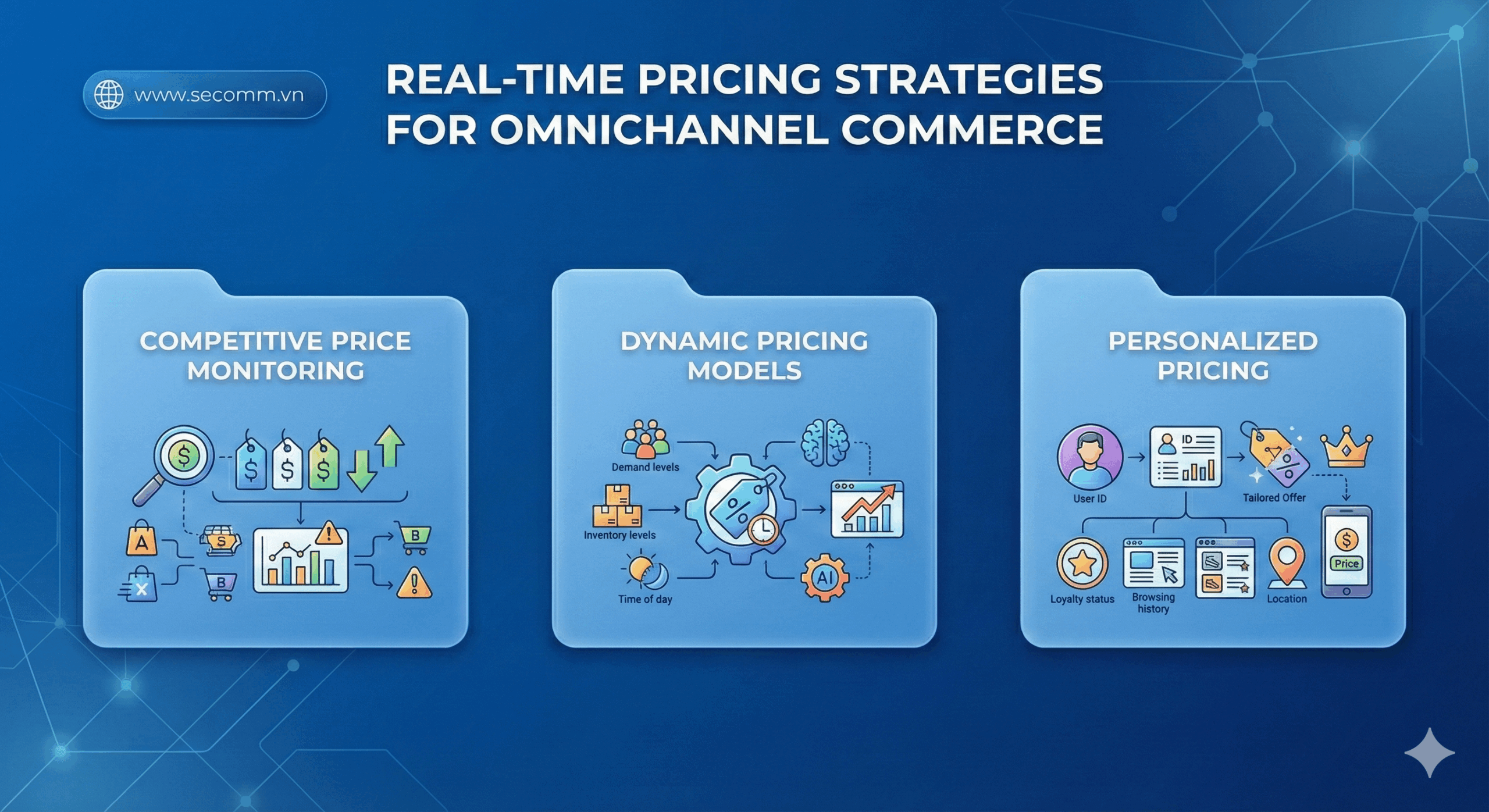
Real-Time Pricing Strategies for Omnichannel Commerce 

Real-Time Pricing Strategies for Omnichannel Commerce

Dynamic pricing is another powerful AI use case, allowing retailers to adjust prices in real time based on demand, competition, and other market variables. This is particularly important for omnichannel retail, where price consistency and responsiveness are critical to customer trust. 

Competitive Price Monitoring 

AI algorithms can continuously monitor competitors’ prices and adjust a retailer’s prices accordingly, helping maintain competitiveness while protecting margins. This is essential in an environment where customers can compare prices across platforms within seconds. 

Dynamic Pricing Models 

By leveraging historical sales data, seasonal trends, and customer behavior, AI models can determine optimal price points to maximize both revenue and profit. For instance, AI can increase prices during peak demand periods or trigger markdowns for slow-moving inventory to accelerate sell-through. 

Personalized Pricing 

Personalized pricing focuses on offering individual discounts or loyalty incentives based on each customer’s shopping behavior. By analyzing purchase frequency, loyalty, and spending patterns, AI can generate tailored offers that drive engagement and increase customer lifetime value. 

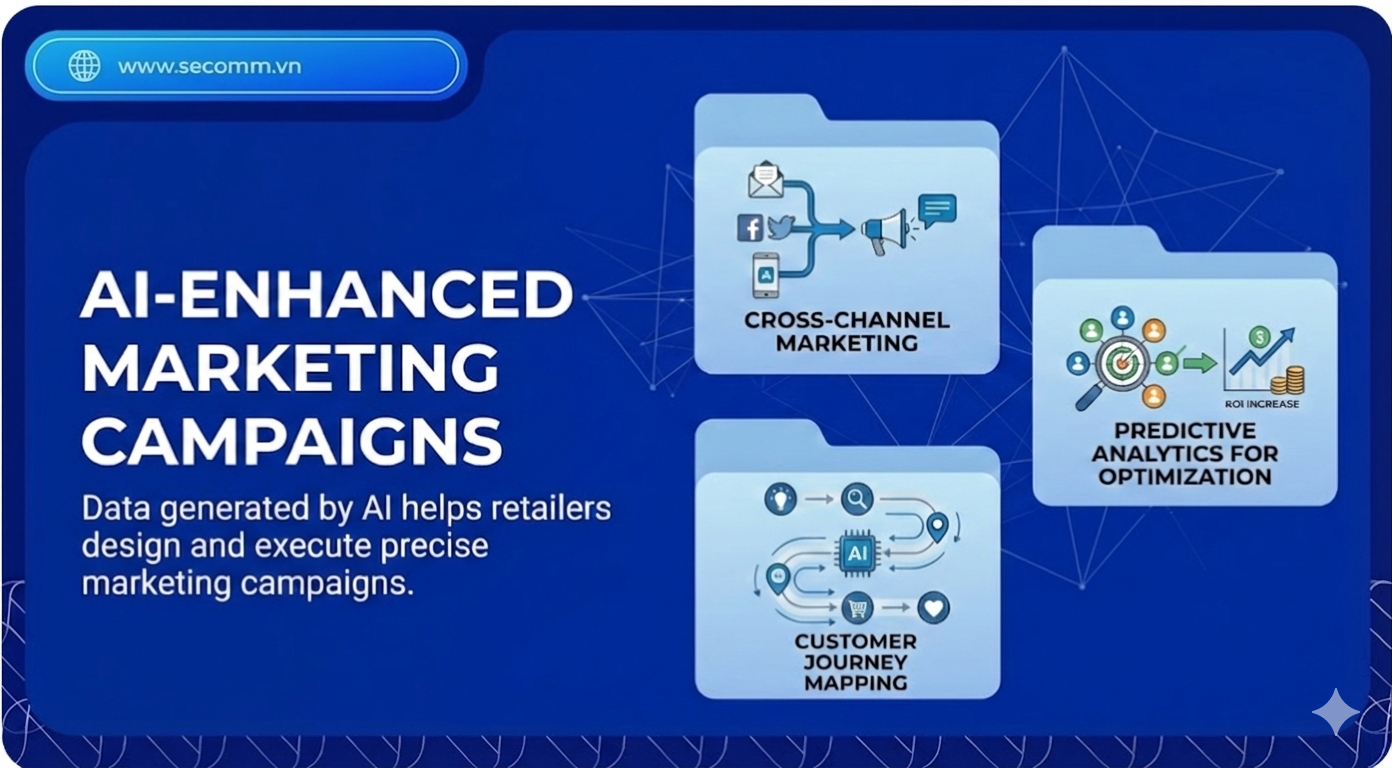
AI-Enhanced Omnichannel Marketing Campaigns

AI-Enhanced Omnichannel Marketing Campaigns

AI-generated insights empower retailers to design and execute more precise marketing campaigns, ensuring they reach the right customers at the right time. Multichannel data analysis makes marketing strategies more targeted and more efficient. 

Omnichannel Marketing Campaigns 

AI enables retailers to orchestrate integrated omnichannel marketing campaigns that reach customers via email, social media, mobile apps, and other digital touchpoints. This integration ensures consistent messaging, regardless of where customers interact with the brand. 

Predictive Analytics for Campaign Optimization 

Predictive analytics can identify which customer segments are most likely to respond to a given promotion, allowing marketers to optimize budget allocation. Campaigns can be adjusted in real time based on performance metrics, increasing ROI and engagement rates. 

Customer Journey Mapping 

With AI, retailers can build detailed customer journey maps to understand how each touchpoint influences purchase decisions. This data supports hyper-targeted marketing at every stage-from awareness and consideration to conversion-enabling businesses to design strategies aligned with customer needs at each step. 

Challenges of Applying AI in Omnichannel Retail 

While AI offers transformative advantages for Omnichannel retail, practical implementation remains fraught with strategic hurdles. To fully harness the potential of this technology, enterprises must identify and resolve four core challenges: 

  • Data Ethics and Security: Data privacy, cybersecurity, and algorithmic bias are paramount concerns. AI applications must ensure transparency, ethical integrity, and strict compliance with global legal regulations.  
  • Operational Adaptation: Transitioning from traditional models to AI integrated systems requires high agility in operational processes across all customer touchpoints.  
  • Resources and Governance: Maximizing AI’s utility demands structured investment in staff training, standardized data management systems, and continuous system maintenance.  
  • System Innovation: The most significant barrier lies in the seamless synchronization of data between legacy systems and modern platforms to create a centralized, consistent data architecture. 

Faced with complex operational and data architecture challenges, businesses require a partner with proven technical expertise. With extensive experience in deploying complex eCommerce systems, SECOMM stands as a reliable partner, helping enterprises mitigate technical risks, optimize costs, and accelerate time-to-market. 

Read more: Strategies for Applying AI in eCommerce to Enhance Operational Efficiency and Sales

Conclusion: Are You Ready for the Omnichannel AI Era? 

AI is transforming omnichannel retail by enabling seamless integration across all customer touchpoints, from personalized recommendations to intelligent inventory management. As retailers continue to innovate, AI-driven omnichannel strategies will sit at the heart of superior shopping experiences, stronger brand loyalty, and sustainable profitability. 

Are you ready for a new wave of retail transformation in 2026? With more than 10 years of experience delivering specialized eCommerce solutions for leading enterprises in Vietnam and overseas markets, SECOMM is ready to partner with you to build a secure, scalable, and high-performing omnichannel ecosystem. 

Contact SECOMM today for tailored omnichannel consulting that aligns with your business model and long-term growth strategy. 

50
5,853
1
20
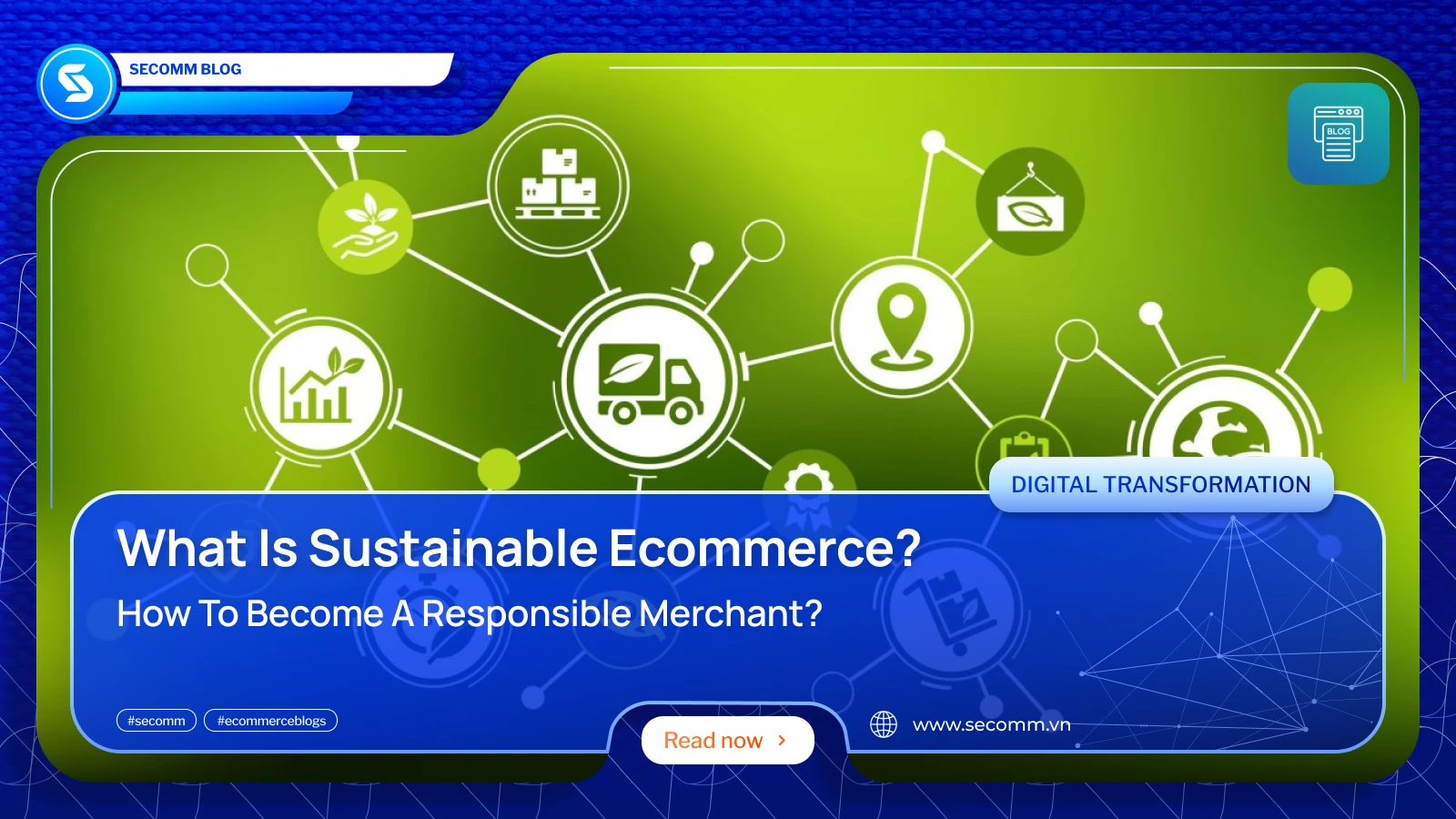
What is Sustainable eCommerce? How to Become a Responsible Merchant?

eCommerce has become an integral part of our daily lives, offering unparalleled convenience and access to a vast array of products. However, as the industry continues to grow, so does its environmental footprint. From excessive packaging waste to carbon emissions from shipping, the environmental impact of eCommerce cannot be ignored. This brings us to the concept of sustainable eCommerce—a transformative approach that seeks to minimize the negative environmental effects of online retail while promoting ethical business practices.

Sustainable eCommerce is not just a trend; it’s a response to the increasing consumer demand for environmentally friendly and socially responsible products. A survey shows that 72% of respondents reported that they were actively buying more environmentally friendly products than they did five years ago, while 81% said they expected to buy even more over the next five years.

In this blog, we will delve into the essence of sustainable eCommerce, explore its importance, examine the growing demand for it, and provide practical steps on how you can become a responsible merchant.

What is sustainable eCommerce?

Sustainable eCommerce refers to the practice of conducting online business in a way that minimizes environmental impact and promotes social responsibility. At its core, it involves making mindful decisions at every stage of the business process, from product sourcing and manufacturing to packaging, shipping, and customer engagement. The goal is to reduce the carbon footprint, minimize waste, and ensure that ethical standards are upheld throughout the supply chain.

Key components of sustainable eCommerce

There are some common components in the eCommerce sustainability, including:

Eco-Friendly Products

Offering products that are made from sustainable materials, are biodegradable, or have a lower environmental impact is crucial. This means choosing materials that are renewable, such as organic cotton or bamboo, over conventional materials that may deplete natural resources or cause pollution. Additionally, promoting products that are ethically sourced ensures that they are produced under fair labor conditions, respecting workers’ rights and contributing to social sustainability.

Sustainable Packaging

Sustainable packaging involves using materials that can be recycled, are biodegradable, or are made from recycled content. For instance, using cardboard boxes made from recycled paper or packing peanuts that are biodegradable can greatly reduce the environmental footprint. This approach not only minimizes waste but also appeals to environmentally conscious consumers.

Energy Efficiency

Reducing energy consumption in the warehousing and logistics aspects of eCommerce is another critical component. This can be achieved by:

  • Using Renewable Energy: Powering warehouses and offices with solar, wind, or other renewable energy sources.
  • Optimizing Delivery Routes: Using route optimization software to minimize fuel usage and emissions during delivery.
  • Investing in Energy-Saving Technologies: Implementing LED lighting, energy-efficient HVAC systems, and other technologies that reduce overall energy consumption.

Waste Reduction

Minimizing waste throughout the entire eCommerce process is essential. This involves:

  • Efficient Inventory Management: Using systems that prevent overstocking and reduce the likelihood of unsold goods going to waste.
  • Recycling Programs: Implementing robust recycling programs in warehouses and encouraging customers to recycle packaging materials.
  • Designing Durable Products: Creating products with a longer life cycle, which reduces the need for frequent replacements and lowers the overall waste generated.

Ethical Business Practices

Ensuring that all business practices are ethical and transparent is fundamental to sustainable eCommerce. This includes:

  • Fair Labor Practices: Treating all employees and suppliers fairly, ensuring safe working conditions, and providing fair wages.
  • Supporting Fair Trade: Sourcing products that adhere to fair trade principles, which support better prices, decent working conditions, and fair terms of trade for farmers and workers in developing countries.
  • Transparency: Being open and honest with consumers about the sustainability efforts and practices of the business. This can build trust and loyalty among customers who value ethical and responsible business operations.

By integrating these key components to strategies, eCommerce businesses can significantly reduce their environmental impact, support social responsibility, and meet the growing demand from consumers for more sustainable and ethical products.

Why is eCommerce sustainability important?

Understanding the importance of eCommerce sustainability is crucial for businesses looking to thrive in today’s market. Here are several reasons why adopting sustainable practices in eCommerce is vital:

Environmental Impact

The environmental impact of traditional eCommerce practices is significant. From the excessive use of plastic packaging to the carbon emissions from shipping and logistics, the eCommerce industry contributes to environmental degradation. By adopting sustainable practices, businesses can significantly reduce their carbon footprint, decrease pollution, and help conserve natural resources. Sustainable eCommerce practices, such as using eco-friendly packaging and optimizing delivery routes, play a vital role in mitigating the industry’s environmental impact.

Consumer Behavior

Consumer behavior is shifting towards sustainability. More and more customers are becoming environmentally conscious and prefer to purchase from brands that align with their values. Studies show that a growing number of consumers are willing to pay a premium for products that are sustainably produced and packaged. By adopting sustainable practices, eCommerce businesses can meet this demand, attract a broader customer base, and enhance customer loyalty. Being a responsible and eco-friendly brand can also differentiate a business in a crowded market.

Business Benefits

Sustainable eCommerce practices can lead to significant business benefits. These include cost savings from reduced waste and energy consumption, improved brand reputation, and increased customer loyalty. Businesses that prioritize sustainability can also access new markets and opportunities, such as partnerships with other eco-friendly brands and certifications that can enhance credibility. Additionally, sustainable practices can lead to innovation, as companies find new ways to reduce their environmental impact and improve efficiency.

Regulatory Compliance

Governments and regulatory bodies are increasingly implementing stricter environmental regulations. Businesses that do not comply with these regulations risk facing fines, penalties, and damage to their reputation. By adopting sustainable practices, eCommerce businesses can stay ahead of regulatory changes, ensure compliance, and avoid potential legal issues. Proactively embracing sustainability also positions businesses as leaders in their industry, setting an example for others to follow.

Long-Term Viability

Sustainability is essential for the long-term viability of businesses. As natural resources become scarcer and environmental issues become more pressing, companies that do not adopt sustainable practices may face higher costs and supply chain disruptions. By integrating sustainability into their business model, eCommerce companies can ensure they are resilient to future challenges and are better prepared for a changing market landscape. Sustainable practices also contribute to a positive corporate image, which can attract investors and stakeholders who prioritize responsible business operations.

How to become a sustainable eCommerce business

Becoming a sustainable eCommerce business involves implementing practices that minimize environmental impact and promote social responsibility. Here are key steps to help you achieve sustainability:

Optimize Supply Chain

Optimizing your supply chain is crucial for sustainability. This involves sourcing materials and products from suppliers who adhere to ethical and environmental standards.

  • Ethical Sourcing: Choose suppliers that provide eco-friendly materials, such as recycled or renewable resources. Ensure that these suppliers follow fair labor practices and maintain high environmental standards.
  • Local Suppliers: Whenever possible, source products locally to reduce the carbon footprint associated with long-distance transportation.
  • Supplier Audits: Regularly audit your suppliers to ensure they comply with your sustainability criteria and make improvements where necessary.

Optimize Shipping Strategy

Shipping is a significant contributor to the environmental footprint of eCommerce. Optimizing your shipping strategy can help reduce emissions and improve efficiency.

  • Route Optimization: Use software to plan the most efficient delivery routes, reducing fuel consumption and emissions.
  • Eco-Friendly Shipping Options: Offer customers eco-friendly shipping options, such as slower shipping methods that are less carbon-intensive.
  • Carbon Offsetting: Invest in carbon offset programs to compensate for the emissions generated by shipping activities. This can include projects like reforestation or renewable energy initiatives.

Offer Recyclable Packaging

Packaging is a major source of waste in eCommerce. Switching to recyclable packaging can significantly reduce environmental impact.

  • Sustainable Materials: Use packaging materials that are recyclable, biodegradable, or made from recycled content, such as cardboard, paper, or compostable plastics.
  • Minimal Packaging: Design packaging to be minimal yet protective, reducing the amount of material used.
  • Customer Education: Include clear instructions on how customers can recycle or dispose of packaging materials responsibly. You can also encourage customers to reuse packaging for other purposes.

Join Environmental Charities

Supporting environmental charities and initiatives can enhance your sustainability efforts and demonstrate your commitment to making a positive impact.

  • Partnerships: Partner with environmental organizations to support projects like reforestation, conservation, or clean energy. This not only contributes to environmental sustainability but also enhances your brand image.
  • Donations: Allocate a portion of your profits to donate to environmental causes. Publicize these efforts to show customers that their purchases contribute to a greater good.
  • Employee Engagement: Encourage your employees to participate in environmental volunteer activities and promote sustainability within your organization.

By implementing these strategies, your eCommerce business can significantly reduce its environmental impact, meet the growing demand for sustainable practices, and build a loyal customer base that values social responsibility. Adopting sustainability is not only good for the planet but also beneficial for your business’s long-term success.

Final words

eCommerce sustainability is no longer a luxury but a necessity. Consumers are increasingly prioritizing eco-friendly and socially responsible brands, and businesses must adapt to meet this demand. Embracing sustainable eCommerce practices, businesses can make informed decisions that contribute to a healthier planet.

80
3,285
1
27
Top 14+ Brands Migrate from WooCommerce to Shopify Plus Pt3

Building upon the narratives in parts 1 and 2, this third part invites you to delve into the stories of the remaining brands within the series of 14 that migrate from WooCommerce to Shopify Plus. Explore how this strategic decision has led to their success in terms of sales and paved the way for sustainable growth in the future.

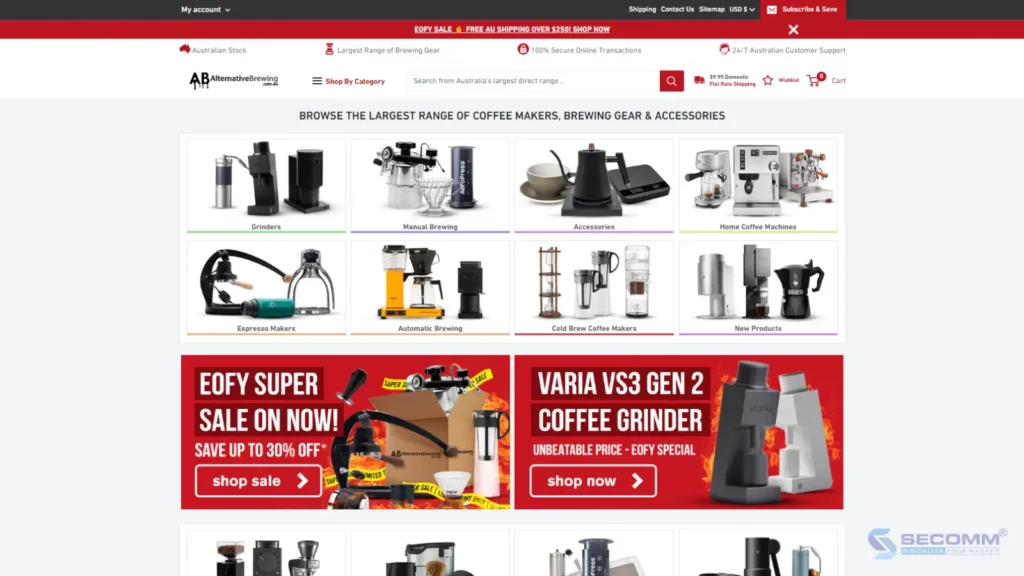
1. Alternative BrewingAlternative Brewing

Alternative Brewing is a leading brand in Australia specializing in providing high quality coffee making equipment and utensils. After operating on WooCommerce, Alternative Brewing encountered a problem. WooCommerce eCommerce websites require constant maintenance, causing a lot of worry on shopping occasions like Black Friday or Cyber Monday.

Within 4 months of converting to the Shopify Plus platform, Alternative Brewing’s new eCommerce website loaded faster and had faster checkout, helping the brand significantly increase average order value. Shopify Plus platform with an intuitive, user-friendly interface, Alternative Brewing does not need to deal with a lot of complicated code. This allows the Alternative Brewing team to focus on growing their business and make more informed decisions with Shopify’s in-depth reports and analytics.

Website: https://alternativebrewing.com.au/

Industry: FnB

Traffic: 919,295/month

Rank: #3,071 (Australia) & #144,195 (Global)

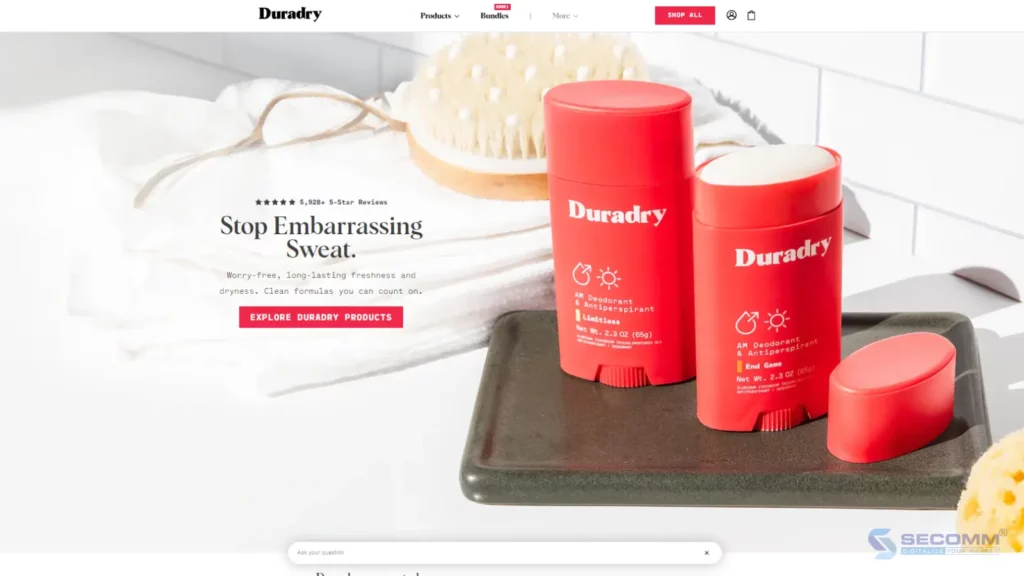
2. DuradryDuradry

Duradry is a leading personal care brand that offers effective antiperspirant products. Operating on WooCommerce costs Duradry a lot of money when testing many different marketing campaigns. The brand migrated to the Shopify Plus platform to take advantage of many exclusive tools and solutions that help them optimize operations and deploy marketing processes more effectively.

Duradry also leverages Shopify Collabs to partner with popular content creators to drive marketing success, bringing Duradry products to more potential customers. The result was 250 content creators joining Duradry’s community, $50k in sales through Shopify Collabs in less than 7 months.

Website: https://duradry.com/?view=hero-a

Industry: Beauty & Cosmetics

Traffic: 386,080/month

Rank: #119,405 (USA) & #445,775 (Global)

3. AMR Hair & BeautyAMR Hair & Beauty

AMR Hair & Beauty is one of the leading suppliers of hair care and beauty products in Australia. Established in 2004, AMR has quickly grown to become a trusted destination for hair salons and individual consumers.

Although WooCommerce has served AMR Hair & Beauty well for many years, with the rapid growth of the business, the platform began to show its limitations. Among them are limited scalability, difficult order management, poor security, and suboptimal customer support.

After switching to Shopify Plus, AMR Hair & Beauty leveraged the B2B on Shopify solution to build a wholesale store and further customize advanced search features and filtering options. This means AMR Hair & Beauty’s B2B customers can quickly narrow down search results and view products along with prices and offers. As a result, AMR Hair & Beauty increased sales by 200%, average B2B order value by 77%, and conversion rate by 93%.

Website: https://amr.com.au/

Industry: Beauty & Cosmetics

Traffic: 258,448/month

Rank: #8,360 (Australia) & #381,873 (Global)

4. Abode LivingAbode Living

Abode Living was founded in 1991 and since then the brand has become Australia’s leading supplier of luxury bed linen, using the highest quality European fabrics and sewing products in its own factories. I’m in Australia.

With the need to increase online sales in Australia and other markets, and upgrade customer experience. However, the previous platform the company used, WooCommerce, did not offer enough flexibility to customize advanced features. WooCommerce also doesn’t give Abode Living the ability to add international marketplaces to its existing eCommerce system. Switching to Shopify Plus met all of Abode Living’s goals. The brand saw a 15% increase in average order value, faster page load speeds, and faster responses.

Website: https://www.abodeliving.com/

Industry: Home Funishing

Traffic: 16,645/month

Rank: #57,874 (Australia) & #2,352,607 (Global)

Final Words

So, SECOMM has gathered insights from 14 representative brands that courageously stepped out of the “WooCommerce world” to revamp their eCommerce websites with Shopify Plus. These brands prioritize customer experience and streamlined processes, inspiring others to confidently opt for platform migration.

Contact SECOMM or call directly at (+84)28 7108 9908 for advice and implementation of the eCommerce migration process from WooCommerce to Shopify Plus today!

2
4,285
0
1
Latest ebooks
Building A Wine eCommerce Website With Magento
One of the highest requirements when implementing wine eCommerce website is a system with high complexity.
4
28
0
4
Building A Comprehensive eCommerce Website For The Grocery Industry
This eBook is a must-read for businesses looking to capitalize on the burgeoning eGrocery market and navigate its complexities with proven strategies.
4
38
0
2
The Solution Of O2O Commerce For Businesses In Vietnam
This eBook is a must-read for businesses looking to harness the power of O2O commerce in Vietnam, offering valuable strategies and real-world success stories.
4
33
0
0

    Subscribe for the latest updates and exclusive content!