









It seems we can’t find what you’re looking for. Perhaps searching can help.
Sign Up for newsletter!
Subscribe to get the latest eBook!

Hotline
(+84) 28 7108 9908





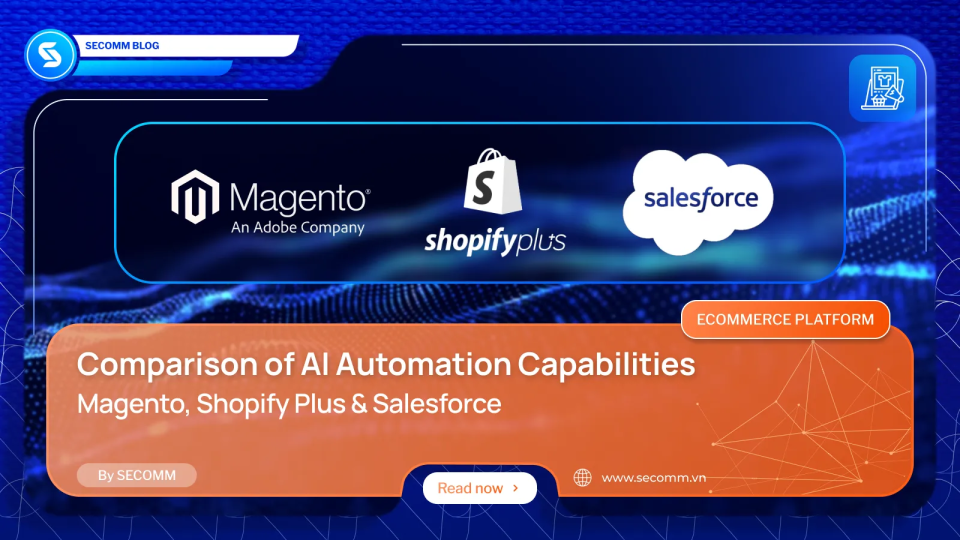
According to a McKinsey AI survey, businesses that effectively implement AI can achieve revenue growth and conversion rates 10% – 30% higher than the average. In the context of rising advertising costs, fragmented customer behavior, and ever-increasing expectations for a “right person – right time – right context” experience, AI automation has become a core competency for every enterprise eCommerce system. This article provides an in-depth comparison of the AI automation capabilities of three leading platforms: Magento (Adobe Commerce), Shopify Plus, and Salesforce Commerce Cloud, helping you determine the optimal choice for your B2B/B2C model and long-term growth strategy.
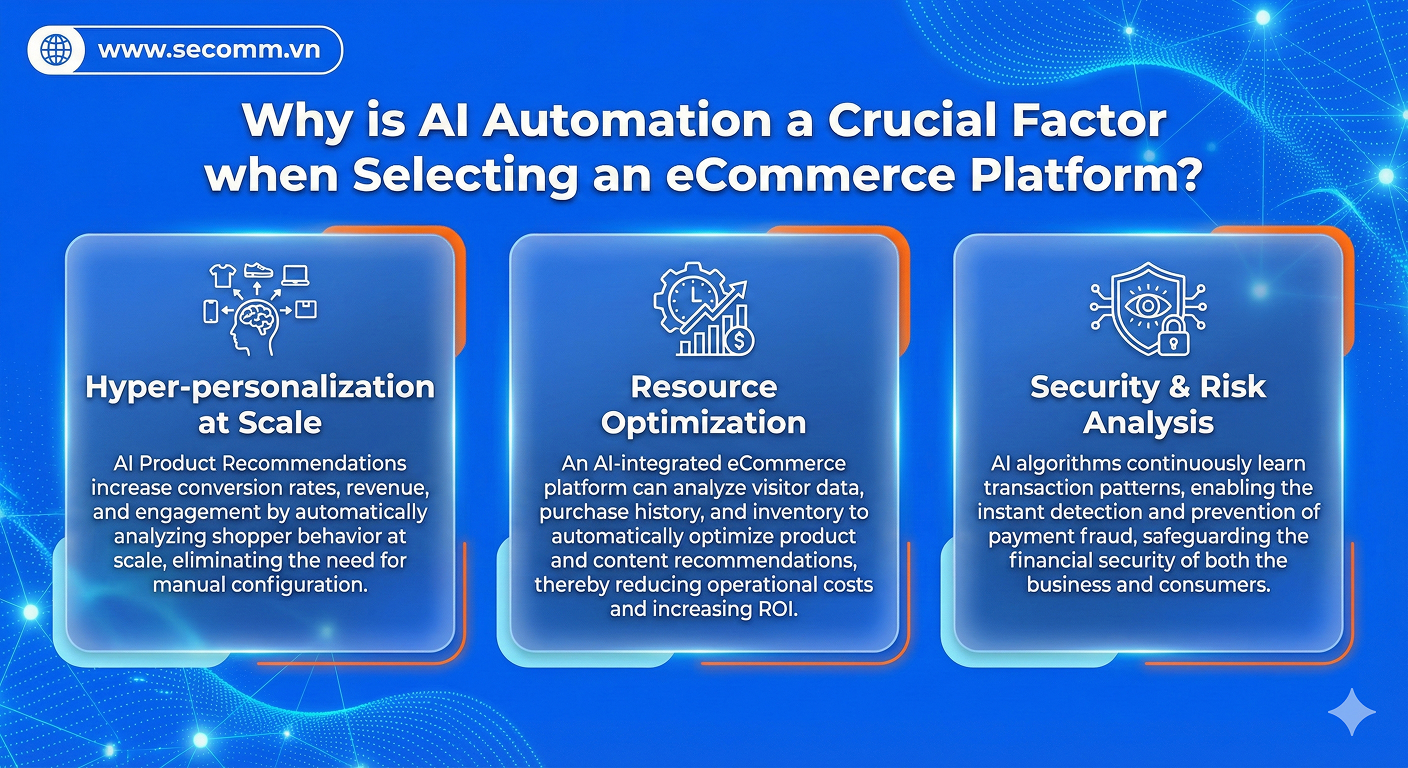
As e-commerce businesses scale up, manual operations often lead to soaring management costs and fragmented customer experiences. Integrating AI Automation into the core platform is an essential technological solution to address these challenges:
Once AI Automation is established as a mandatory factor, the next step for business leaders is to select the core technology that aligns with their scale and specific business model. There is no single “AI formula” that works for every platform. Below is an analysis of the automation capabilities of the three market-leading Enterprise systems.
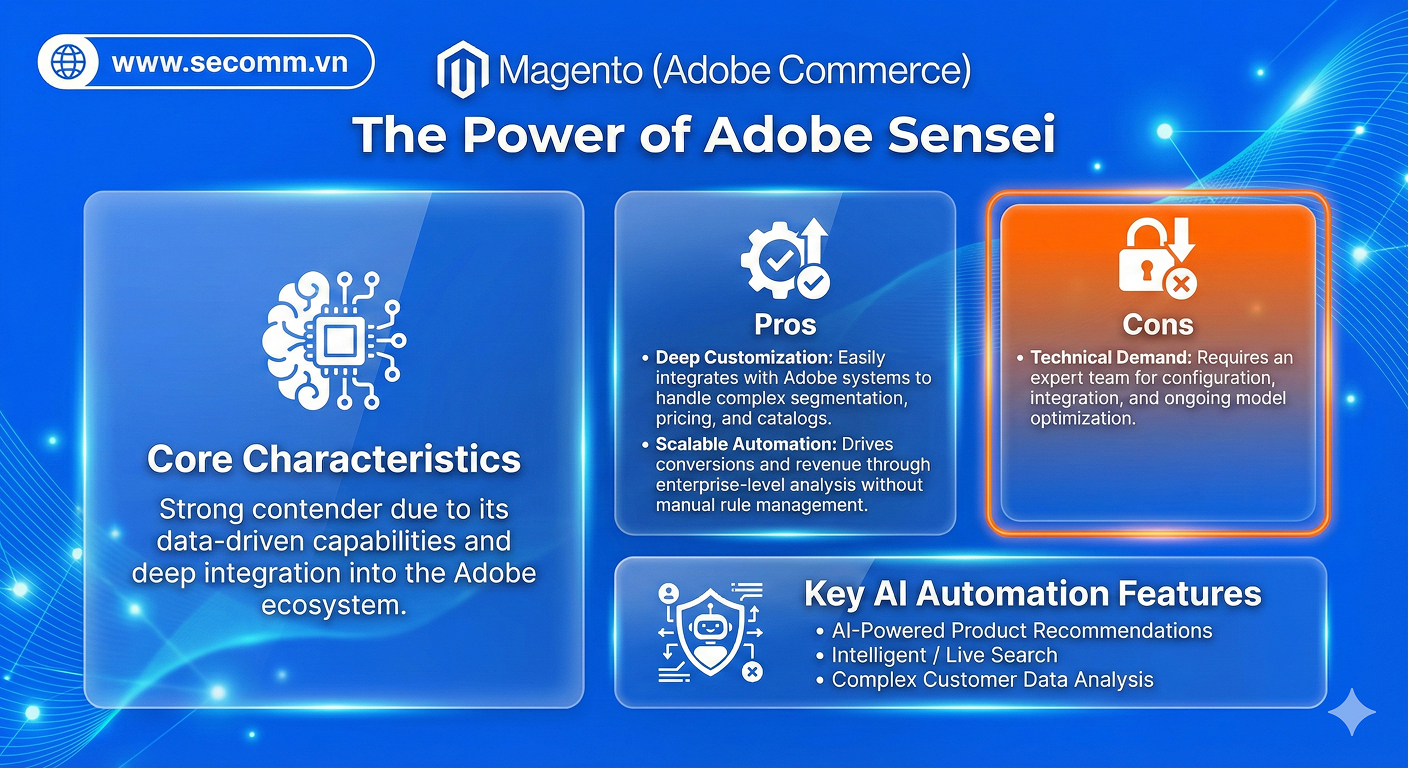
For businesses with complex and massive data structures, Magento (Adobe Commerce) is always a strong contender due to its data-driven capabilities and deep integration into the Adobe ecosystem.
Core Characteristics:
Key AI Automation Features:
Pros:
Cons:
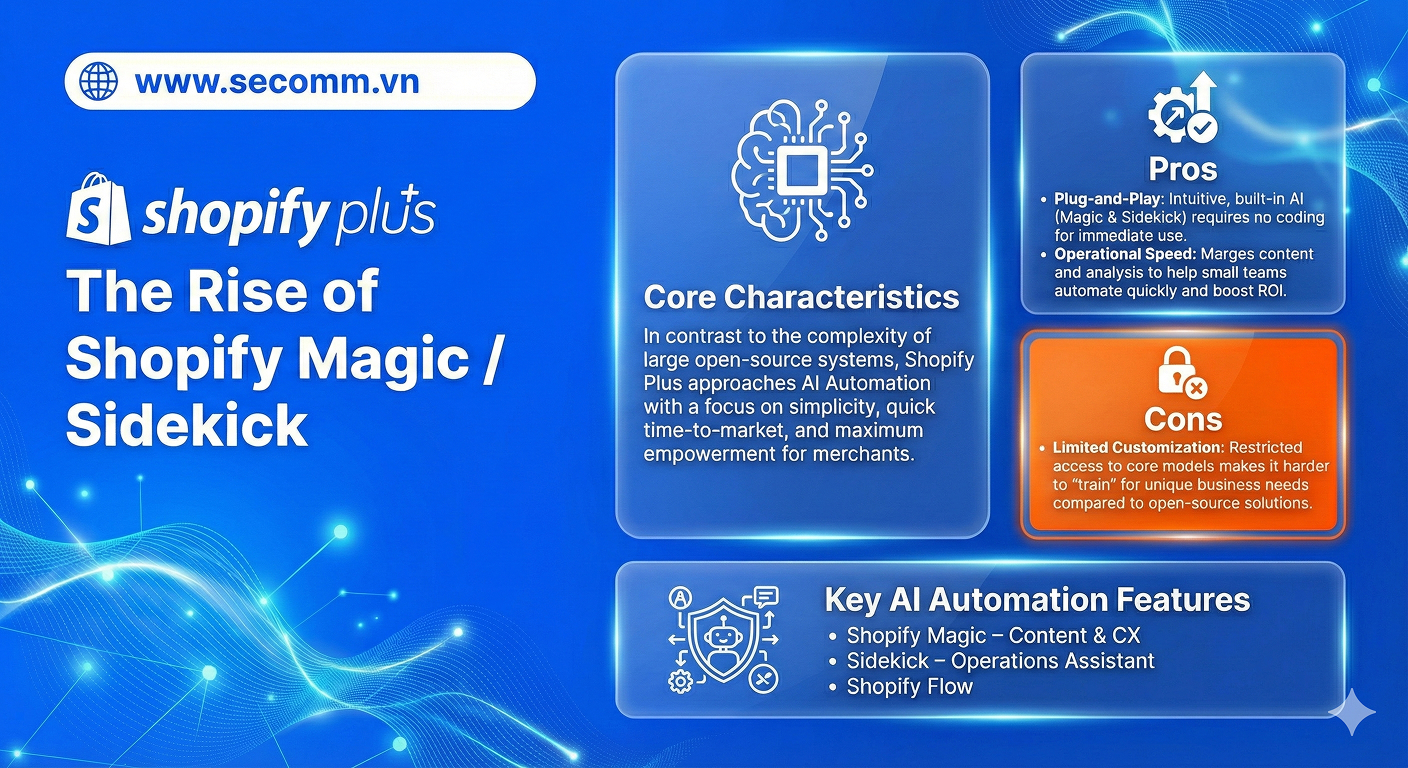
In contrast to the complexity of large open-source systems, Shopify Plus approaches AI Automation with a focus on simplicity, quick time-to-market, and maximum empowerment for merchants.
Core Characteristics:
Key AI Automation Features:
Pros:
Cons:
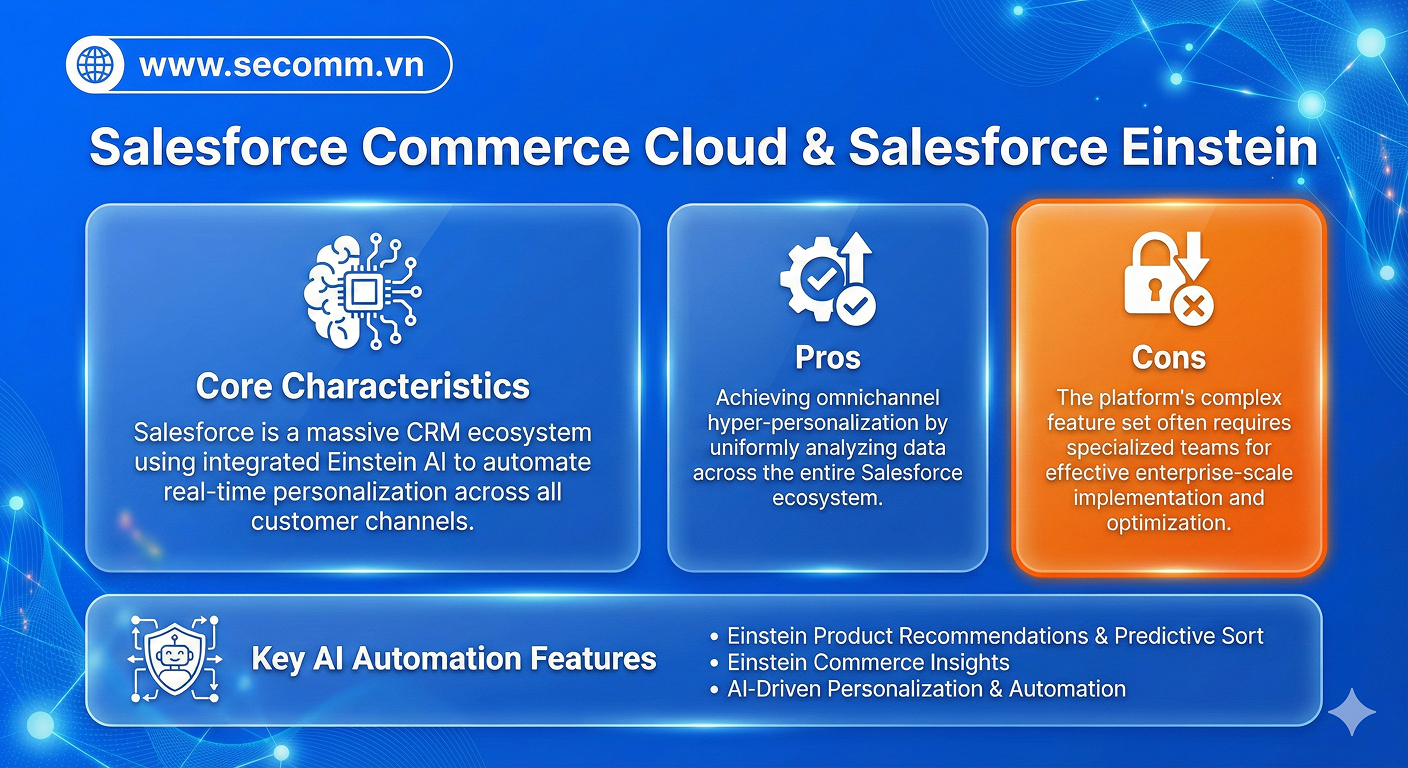
If your Enterprise business is looking for a unified ecosystem across all touchpoints, from marketing and sales to customer service, Salesforce Commerce Cloud offers the most macroscopic level of automation. This platform solves operational challenges with a customer-centric approach.
Core Characteristics:
Key AI Automation Features:
Pros: The greatest strength is realized when a business uses the full Salesforce ecosystem; data from Sales, Service, Marketing, and Commerce is analyzed uniformly by Einstein, supporting omnichannel hyper-personalization.
Cons: Due to the rich feature set, the AI-driven personalization and automation of Commerce Cloud often require specialized teams or partners for enterprise-scale implementation and optimization.
| Criterion | Magento (Adobe Sensei) | Shopify Plus (Magic/Sidekick) | Salesforce Commerce Cloud (Einstein) |
|---|---|---|---|
| Core Strength | Adobe Sensei AI/ML for product recommendations, intelligent search, and automated merchandising. | Shopify Magic + Sidekick AI suite for content creation and store operation via natural language, merchant-friendly. | Einstein AI deeply integrated with the entire Salesforce ecosystem for omnichannel personalization and merchandising automation. |
| Content AI | Sensei supports product suggestions, segmentation, and smart merchandising; content copy often uses third-party solutions. | Shopify Magic automatically generates product descriptions, emails, and marketing content within the Admin. | Einstein can generate personalized product descriptions and dynamic content within Commerce Cloud. |
| Intelligent Search | Live/Intelligent Search understands intent, typos, and synonyms for accurate results. | Advanced search and recommendations are available; capabilities can be enhanced through apps/AI and Sidekick data analysis. | Einstein Predictive Sort arranges results based on customer behavior and preferences. |
| Technical Complexity | High, requires developers and technical teams experienced with Sensei/Adobe Commerce. | Low, merchant-friendly, many AI features are ready to use immediately. | Very High, often requires specialists/partners for enterprise-scale implementation. |
Integrating AI Automation is not merely the purchase of a new tool, but a strategic investment that reshapes the entire operational ecosystem. Magento, Shopify Plus, and Salesforce all possess excellent AI technologies, but there is no single “perfect answer” for every organization.
Businesses do not need to find the world’s strongest platform, but rather the technology “piece” that is perfectly compatible with their business model, current data structure, and system scale-up vision. Here are suggestions for choosing the right platform for your business:
With these differences in AI automation among Magento, Shopify Plus, and Salesforce Commerce Cloud, have you selected the platform that aligns with your operational model, technical resources, and ROI goals?
If your business needs an experienced partner to implement enterprise eCommerce across multiple platforms, from system architecture and AI integration to long-term growth optimization, SECOMM can accompany you from the platform selection consulting phase through technical deployment and long-term operational optimization.
Q1: Which platform offers the best integrated AI Automation for complex B2B businesses?
Magento (Adobe Commerce) is typically the most optimal choice for complex B2B models. Supported by Adobe Sensei, the platform can handle massive data volumes related to dynamic pricing, diverse product catalogs, and personalize the shopping experience based on business accounts. However, setup requires a highly specialized technical team.
Q2: Is implementing AI Automation on Shopify Plus complex and costly?
No. Shopify Plus is designed with a merchant-friendly philosophy for ease of use. AI tools like Shopify Magic (content generation) and Sidekick (admin assistant) are integrated and can be used immediately without complex code intervention. This helps businesses optimize initial deployment costs (TCO) and achieve ROI more quickly.
Q3: I am currently using the Salesforce CRM system. Am I required to use Salesforce Commerce Cloud for the best AI Automation?
It is not mandatory, but highly recommended. If your business has heavily invested in the Salesforce CRM ecosystem, using Commerce Cloud will help maximize the power of Salesforce Einstein. Customer data from Sales, Service, and eCommerce will be synchronized and analyzed by the same “AI brain,” creating the most seamless and deeply personalized Omnichannel experience. However, you can still integrate Salesforce CRM with Magento or Shopify Plus via API, although this process will require a greater technical effort.
Q4: Will AI Automation completely replace the eCommerce operations team?
No. The goal of AI Automation is to Optimize, not completely Replace. AI will handle repetitive tasks (like inventory synchronization, product suggestions, draft content writing, basic behavior analysis), thereby freeing up time for human personnel to focus on strategic, creative work, and handling complex customer service issues.
Q5: How can I evaluate the ROI when investing in AI Automation on these platforms?
The ROI of AI Automation can be measured through two main aspects:
 50
50
 5,977
5,977 0
0 20
20Subscribe to get the latest eBook!
Hotline