












It seems we can’t find what you’re looking for. Perhaps searching can help.
Sign Up for newsletter!
Subscribe to get the latest eBook!

Hotline
(+84) 28 7108 9908





According to Gartner research, the average cost of one minute of IT system downtime is $5,600. For large-scale eCommerce platforms during Mega Sale seasons like 11.11 or Black Friday, that figure can multiply many times over, not to mention hundreds of customers lost to competitors simply because an error page appeared right when they were about to click “Place Order”.
Building an eCommerce system on Magento or Shopify Plus is only the starting line. For that system to generate consistent, growing revenue over time, maintenance services are an indispensable factor. This is not simply about “fixing errors when the system crashes”, it is a strategy of proactive optimization that keeps businesses one step ahead of risk. In this article, let’s explore eCommerce System Maintenance Services: Strategic Investment or Mandatory Cost?
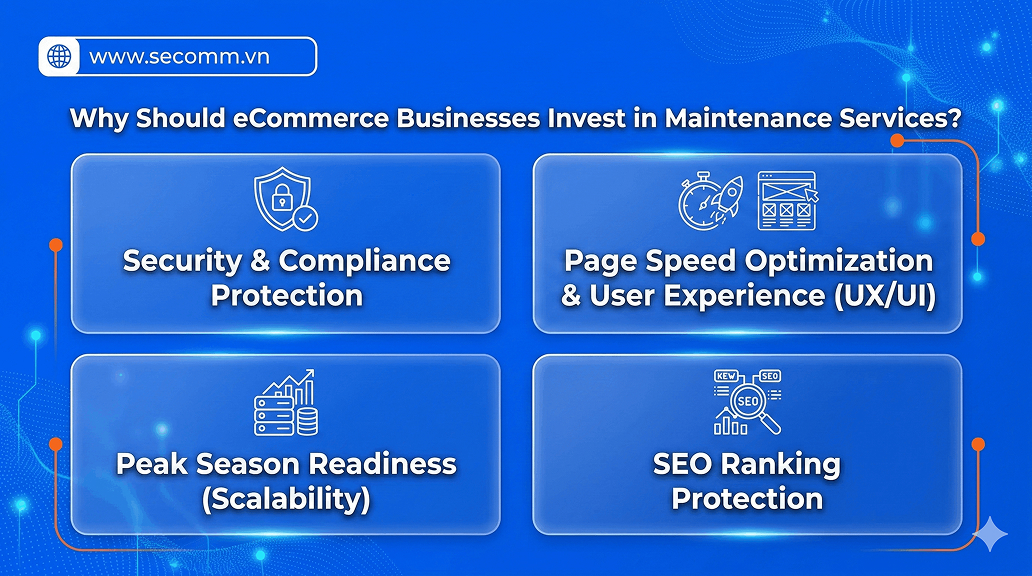
An eCommerce system operates 24/7, processing payment data, personal information, and shopping behavior from thousands of customers every day. Any incident, large or small, directly impacts revenue and brand reputation. Here are 4 key benefits that maintenance services deliver:
eCommerce platforms are prime targets for hackers because they store payment data and customer personal information. Regular maintenance services ensure the system is always updated with the latest security patches, maintains PCI-DSS compliance, and blocks vulnerabilities before malicious actors can exploit them. A data breach not only causes direct financial damage but also destroys customer trust, the intangible asset that is hardest to rebuild.
Accumulated junk data and outdated code will silently slow down a website over time. Google research shows that 53% of mobile users will abandon a webpage if the load time exceeds 3 seconds. A professional eCommerce website maintenance service will regularly clean the database, optimize images, and fine-tune the server to ensure optimal page load speed; thereby protecting the Conversion Rate.
Flash Sales, major holidays, Black Friday; these are periods when traffic can surge 5–10 times compared to normal days. A system that is not properly prepared will easily “break under load”. eCommerce system maintenance before peak seasons includes load testing, server configuration tuning, and database query optimization; the critical factor to ensure revenue is not lost at the most valuable moments.
Google penalizes websites that frequently generate 404 errors, slow load times, or are infected with malware. This means all the budget and effort invested in SEO can be “wiped out” simply because the system lacks proper maintenance. Regular website performance optimization is the sustainable way to protect search rankings long-term.
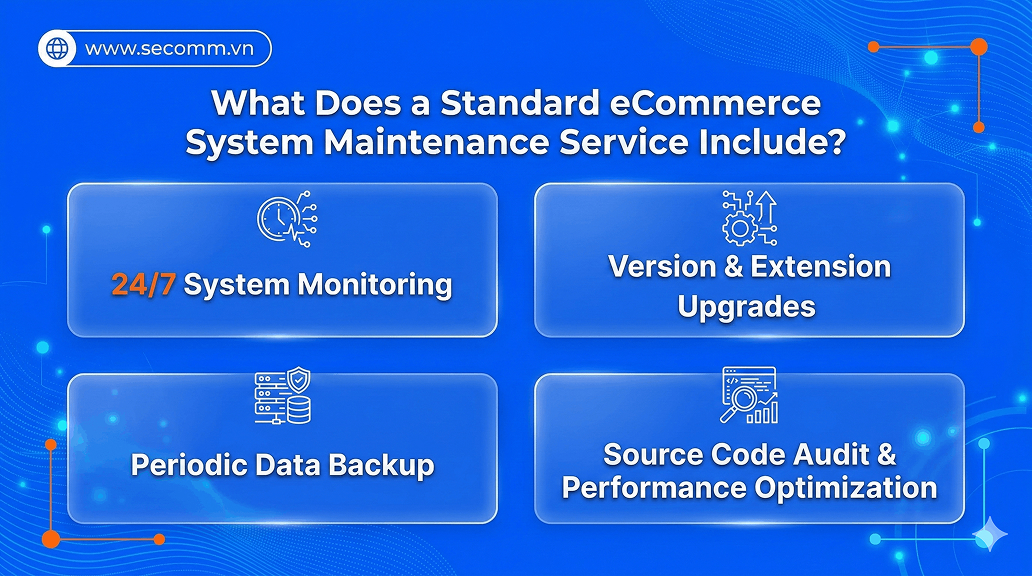
Many businesses confuse “maintenance” with “firefighting”; meaning they only call the technical team when the system already has a problem. A professional eCommerce system maintenance service operates in the opposite direction: prevention over cure.
Using specialized monitoring tools to track uptime, server performance, and traffic anomalies in real time. The goal is to detect and resolve incidents before customers notice ensuring the shopping experience is never interrupted.
Platforms like Magento and Shopify Plus continuously release security updates and new features. The maintenance team ensures upgrades take place in a controlled manner, without disrupting the current system and without causing conflicts with existing extensions.
Setting up automated backup mechanisms on a schedule (daily, weekly) and storing data in multiple secure locations. In the worst-case scenario – a ransomware attack or serious server failure – all transaction data and customer information can be fully restored in the shortest possible time.
Periodic review of the entire codebase to identify and eliminate bottlenecks, optimize database queries, and configure caching; ensuring the system consistently operates at peak performance over time.
| Criteria | In-house Team | Outsourced (Specialist Agency) |
| Cost | High – salaries for senior DevOps, Security Experts, Server Admins | More optimized – costs are shared and structured for businesses |
| Expertise | Limited to internal team capabilities | Access to a diverse team of specialists with hands-on experience |
| Scope | Suitable for basic daily tasks | Capable of solving complex Enterprise-level system challenges |
| SLA Commitment | No formal commitment | Clear, transparent SLA for response and resolution times |
| Flexibility | Difficult to scale quickly during major incidents | Easy to scale up resources on demand |
For mid-to-large eCommerce businesses running on complex platforms like Magento, outsourcing maintenance services to a specialist agency typically delivers significantly higher ROI; businesses focus on growth while the technical experts handle the rest.
The cost of professional eCommerce system maintenance is always far less than the actual damage caused by system downtime, security breaches, or lost SEO rankings after years of investment. This is not a mandatory expense; it is an investment in protecting digital assets and sustaining long-term revenue growth.
A well-maintained eCommerce system is the foundation for businesses to confidently expand into new markets, launch major campaigns, and face the growing competitive pressure of the eCommerce industry.
SECOMM is not just a website design and deployment agency; we are a long-term technology partner providing in-depth maintenance and operations services for complex platforms including Magento, Shopify Plus, and more.
What sets SECOMM apart:
Professional eCommerce maintenance includes: 24/7 system monitoring, version and extension updates, periodic data backups, security patching, performance optimization, and source code audits. It is a proactive activity; not simply fixing errors after they occur.
Tasks like monitoring and backups should be performed continuously (daily). Security updates should be applied as soon as new patches are released. Comprehensive performance audits should be conducted at least once per quarter.
Cost depends on system scale, the platform used (Magento, Shopify Plus, etc.), and the scope of services. Typically, agencies offer monthly maintenance packages with clearly defined SLAs, making it easy for businesses to budget and plan.
eCommerce systems store payment data (credit cards, digital wallets) and customer personal information — the most valuable data for hackers. A successful attack not only causes financial damage but also violates data protection regulations and permanently damages brand reputation.
In-house teams are well-suited for daily operational tasks but often lack the depth to cover all domains (security, DevOps, performance optimization). A specialist agency provides a multi-disciplinary team, SLA guarantees, and experience managing multiple Enterprise systems — typically delivering better ROI at a lower total cost.
Key warning signs include slower-than-usual page load speeds, unexplained drops in conversion rate, 404 or 500 errors appearing, security warnings from Google Search Console, or a system that has not been updated in more than 6 months.
 50
50
 5,966
5,966 0
0 20
20Subscribe to get the latest eBook!
Hotline